What Does 'Hypoallergenic' Jewelry Actually Mean? (It's Not a Guarantee)
October 20, 2026 · 6 min read
Here's something most jewelry stores would rather you didn't know: "hypoallergenic" is not a protected word. There is no government agency, no laboratory standard, and no legal definition standing behind it. Any brand, of any quality, can stamp it on any piece — plated brass, mystery alloy, whatever — and it's completely legal. So the very first thing to understand about "hypoallergenic jewelry" is that the label, on its own, tells you almost nothing.
Now for the good news, because this story has a genuinely happy ending. The thing that actually makes your ears itch and your neck break out is much more specific than "cheap jewelry," and once you know what it is, shopping for jewelry your skin can live with becomes easy. You stop relying on vague marketing words and start looking at one specific ingredient — the same way you'd read a food label.
Why "hypoallergenic" means almost nothing
The word sounds scientific, which is exactly why it works as marketing. "Hypoallergenic" literally means "less likely to cause an allergy," but in practice it's a self-awarded label with no tests behind it. In cosmetics and jewelry alike, there is no regulatory body that verifies the claim. A seller can call a piece hypoallergenic because it's genuinely skin-friendly, or because it sounds nice on a listing — and the customer has no way to tell the difference from the word alone.
That's not to say every seller is lying. Many are sincere. But "hypoallergenic" is a claim, not a proof, and honest brands tend to back it up with something more specific: the actual metal composition. The phrase to listen for isn't "hypoallergenic" — it's "nickel-free." And that brings us to the real story.
The real culprit: nickel, not "cheapness"
Here's the counterintuitive part. When someone says "I can't wear cheap earrings," what they're usually reacting to isn't the price at all. It's nickel.
Nickel is a cheap, strong, silvery-white metal, and it's the single most common cause of metal allergy on the planet. Roughly 15% of women — and a smaller share of men — have some degree of nickel sensitivity, and for those people, prolonged contact with nickel causes exactly the symptoms you're picturing: red, itchy, flaking skin, sometimes tiny bumps, right where the metal touches. That's allergic contact dermatitis, and it has nothing to do with how "cheap" or "expensive" a piece looks.
Nickel shows up everywhere in jewelry for one boring, practical reason: it's cheap, and it hardens soft metals. It's used in plating over brass or copper, in most "silver-tone" fashion pieces, and even in some white-gold alloys. So the same pair of earrings can be $5 or $50 — if there's nickel in the plating or the alloy, a sensitive person reacts to the nickel, never the price tag.
This is also why people confuse nickel allergy with the classic green skin problem. Green skin is usually copper or brass oxidizing against sweat and lotion — a cosmetic stain, not an allergy, and it washes off. Nickel allergy is a genuine immune reaction, and it doesn't wash off; it itches for days. Different culprit, different metal, different symptom — worth knowing the difference before you blame the wrong piece.
What's actually safe: why sterling silver is the answer
So if "hypoallergenic" is unreliable and nickel is the enemy, what should you actually buy? The honest answer — and the one our whole workshop is built on — is 925 sterling silver.
Sterling silver is 92.5% pure silver alloyed with 7.5% of another metal for strength — and crucially, in quality jewelry that other metal is usually copper, not nickel. Silver and copper are both generally well-tolerated by sensitive skin. That's the real reason sterling silver has its reputation as the "safe" metal: not because of a label, but because of what's actually in it. There's simply no nickel to react to.
The same logic applies to the stones. Moissanite, the gemstone we set in our pieces, is a lab-grown silicon carbide crystal — it's inert, it doesn't tarnish or react with skin, and it holds its brilliance far longer than softer alternatives like cubic zirconia. Nothing about a well-made silver-and-moissanite piece is asking your skin to do anything. It just sits there quietly and sparkles.
And before you worry about the one thing silver does do — tarnish — that's a chemical reaction with air, not with your skin, and it's not an allergy. It's also the easiest thing in the world to fix with a quick polish. Tarnish is cosmetic; nickel allergy is medical. Don't confuse the two.
How to shop for sensitive skin (an honest checklist)
Enough theory. Here's what actually works when you're shopping.
Ask for the alloy, not the buzzword. "Nickel-free sterling silver" tells you something real. "Hypoallergenic" alone tells you nothing. The more specific the description, the more likely the seller knows and cares what's in their metal.
Watch the plating. A piece described as "silver-tone" or "silver-plated" is often a thin layer of silver over brass or nickel — exactly the setup that irritates skin once the plating wears thin and the mystery metal underneath shows through. Solid sterling silver has nothing hidden underneath to be exposed. It's the same reason we're honest about rhodium plating: a coating is nice, but the metal underneath is what your skin eventually meets.
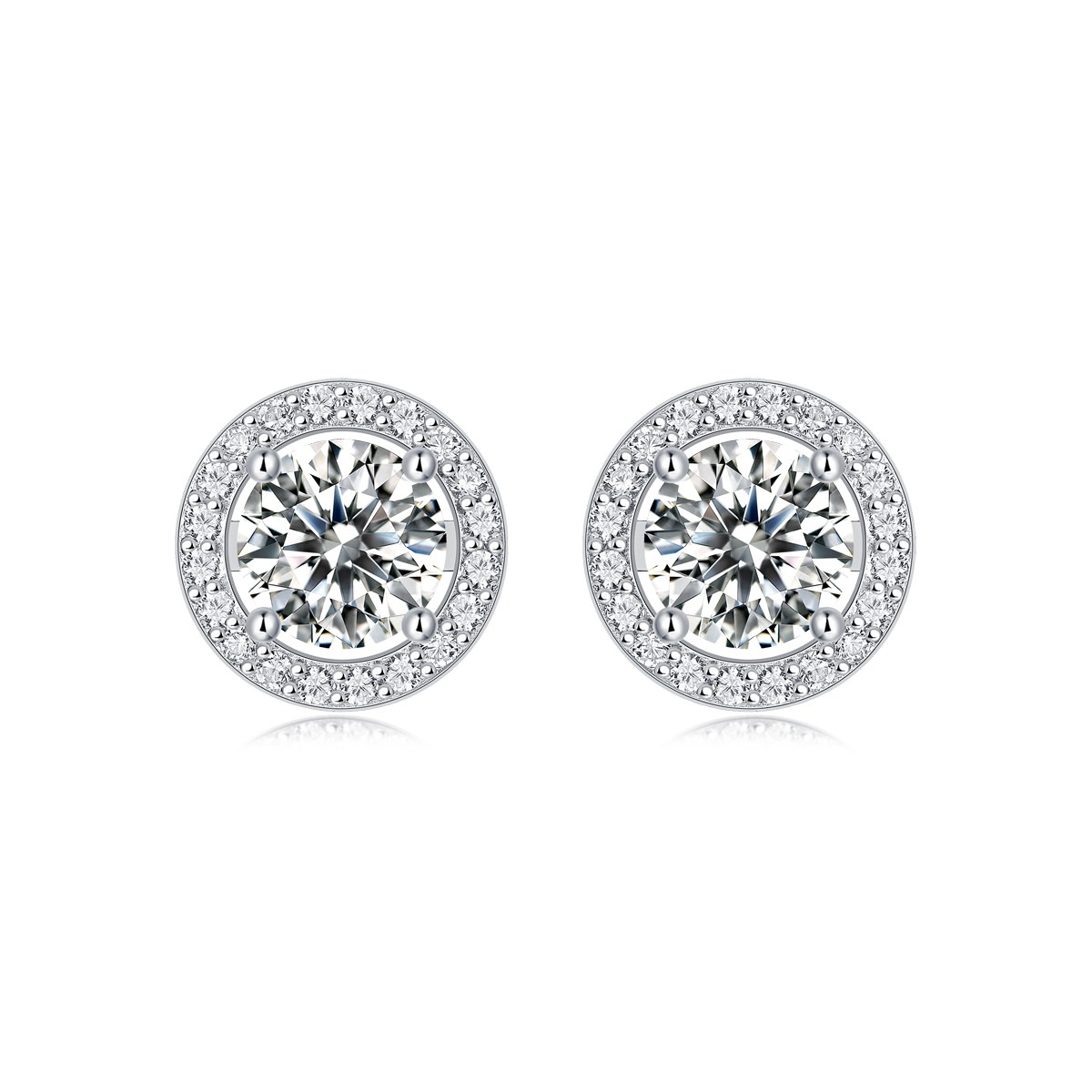
Start with the pieces that touch skin the most. Earrings and necklaces sit directly against skin all day, so they're where reactions show up first. If you're testing whether a metal works for you, start small and start daily — a simple pair of studs like our round halo moissanite studs or a delicate necklace is the gentlest possible introduction.
Give your skin one clean baseline. If everything has been irritating lately, go back to a single, known-safe metal — solid sterling silver — for a week or two and see how your skin settles. Allergies flare up more easily when skin is already inflamed, so a calm, nickel-free baseline is the fastest way to figure out what you're actually reacting to.
That last point is the one I care about most, because it's the opposite of what the industry wants you to do. The industry wants you to keep buying more jewelry in search of "the one that doesn't irritate." The honest path is to remove the variable, identify the culprit (almost always nickel), and then shop with real information instead of hope.
The short version
- "Hypoallergenic" is an unregulated word. No agency verifies it; anyone can put it on any piece.
- The real culprit is nickel, not "cheapness" — it's the most common metal allergen, and it hides in plating and alloys at every price point.
- Nickel allergy is a real immune reaction (itching, redness, bumps) — distinct from the cosmetic green stain of copper and brass.
- Sterling silver is safe because of what's in it — 92.5% silver plus copper, no nickel — not because of a label.
- Moissanite is inert and doesn't react with skin, so the stone is never the problem.
- Shop by alloy, not buzzword. "Nickel-free sterling silver" beats "hypoallergenic" every single time.
- If your skin is upset, reset to solid silver and let it calm down before you diagnose anything.
Keep reading
More from the Journal