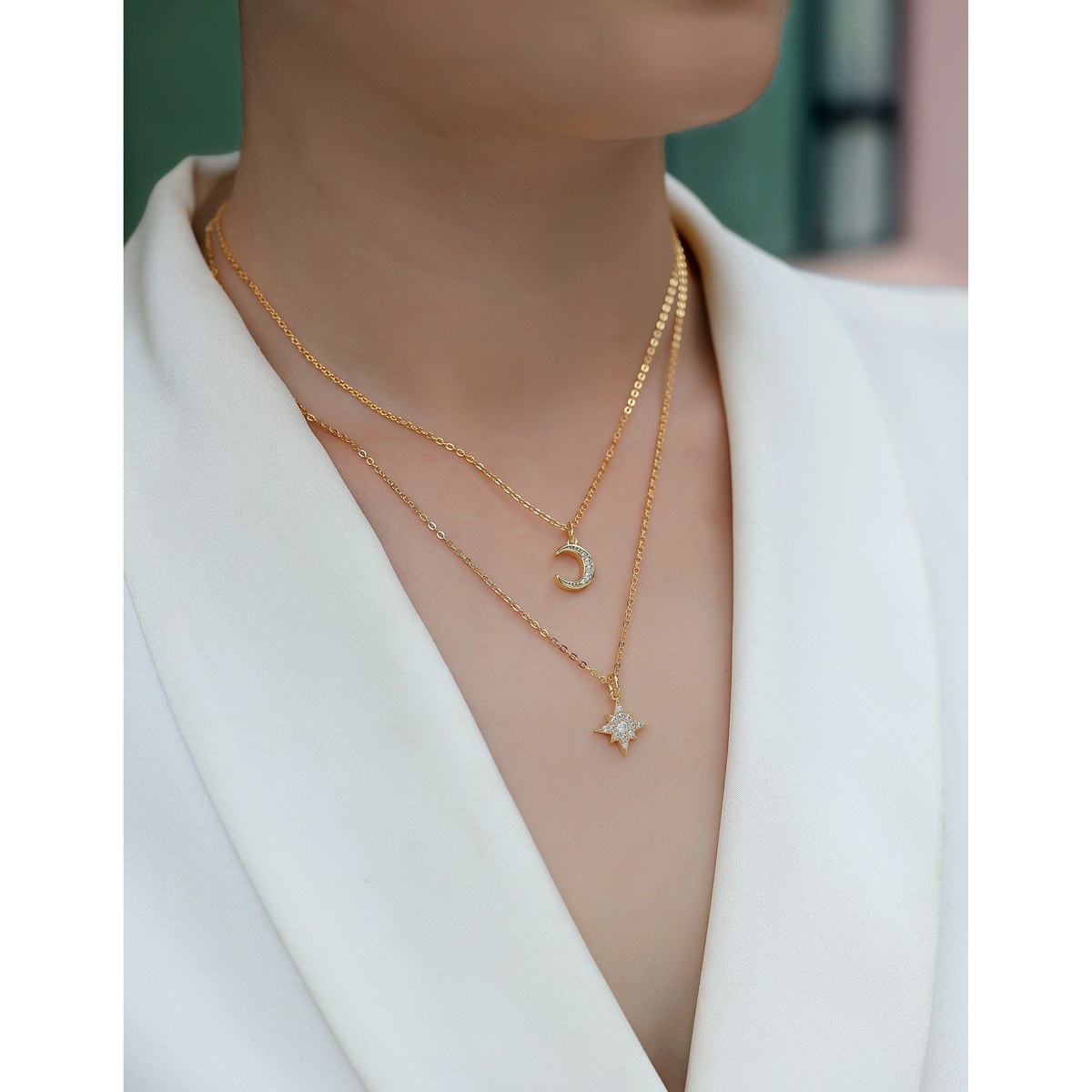
The most brilliant gemstone in fine jewelry wasn't born underground. It fell out of the sky. In 1893, a French chemist named Henri Moissan was sifting through rock from a meteor crater in Arizona when he found tiny crystals so hard and sparkly he was certain he'd discovered diamonds — until tests told him otherwise. What he'd actually found was silicon carbide, a mineral that in nature barely exists in pieces big enough to set in a ring, and which today almost nobody owns in its "natural" form. Here's the twist that confuses everyone: the moissanite on your finger is lab-grown, and that isn't a flaw. It's the entire point.
From a meteor crater to a jewelry box
Natural moissanite is one of the rarest substances on Earth. The microscopic grains Moissan found in that crater are, to this day, the kind you'd need a microscope to admire. No mine produces gem-quality moissanite, and if one somehow did, a single carat would cost a fortune and take an eon to form. So the gemstone trade did the obvious thing: it grew its own.
That's what nearly all moissanite in jewelry is — silicon carbide crystallized in a laboratory, where the conditions that take nature billions of years (and usually require a meteor impact) are reproduced in weeks. This isn't a "simulant" the way cubic zirconia is, a cheap glass-adjacent stand-in trying to pass for something else. Moissanite is a real, distinct mineral with its own chemical identity, its own optical signature, and properties that in some cases beat diamond outright. If the word "lab-grown" makes you hesitate, the honest framing is this: you're not settling for a knockoff. You're choosing a stone that only exists in wearable form because humans learned to make it.
The numbers behind the sparkle
If you know one thing about gemstones, you've probably heard of the Mohs scale, where diamond sits alone at 10 as the hardest natural material. Moissanite lands at 9.25 — harder than sapphire and ruby (9), and comfortably harder than anything you'll bump it against in daily life. Only a diamond or another moissanite can scratch it. That's durability you don't have to think about, which matters more than any sparkle stat if you plan to actually wear the thing.
But the sparkle is where it gets interesting. Two numbers decide how a stone plays with light: refractive index (how much it bends and returns light) and dispersion (how much it splits white light into rainbow fire). Diamond's refractive index is a famously high 2.42. Moissanite's is 2.65 — higher. And on dispersion, the gap is bigger still: diamond scores around 0.044, moissanite around 0.104, more than double. In plain terms, moissanite throws more white brilliance and noticeably more rainbow fire than a diamond of the same cut. That's not marketing. It's a measurable property, and it's why a good moissanite reads as brighter, not merely "almost as good."
There's a reason old diamond testers got fooled by it: moissanite conducts heat almost like diamond does, which is exactly how those testers worked. The stones are genuinely close cousins in behavior, not lookalikes.
The honest part: it's not a diamond, and that's fine
Here's where a lot of moissanite marketing quietly drops the ball, so let's just say it plainly. Moissanite is not a diamond, and if you buy it expecting one, you'll be the only person who notices the difference — but you will notice. Under certain light it can show a faint warmth or a hint of green-grey that a top-tier colorless diamond doesn't have. Its extra fire is gorgeous, but it's a different look, brighter and more colorful than the icier white of diamond. None of this is a defect. It's a personality.
The right reason to buy moissanite is that you like moissanite — the fire, the brightness, the fact that you can own a large, beautiful, nearly indestructible stone without financing it like a car. The wrong reason is that you want to trick someone into thinking it's a diamond. One of those leads to a piece you'll treasure. The other leads to a piece you'll explain away. If you're still weighing the two, our moissanite vs diamond breakdown walks through the honest trade-offs without the sales pitch, and moissanite vs cubic zirconia explains why a hard, bright stone beats a soft, hazy one over the long haul.
Why it makes sense for everyday jewelry
Durability and price are the two things that quietly decide whether a piece becomes a daily-wear staple or a "special occasion only" object. This is where moissanite wins on logic, not emotion. Because it's a 9.25 on the Mohs scale, it shrugs off the scratches, knocks, and hand-washing that would cloud a softer stone within a year. And because it's lab-grown at scale, a stone with real presence costs a small fraction of what an equivalent diamond would — often one-fiftieth to one-hundredth.
That combination — hard, bright, and honestly affordable — is what makes it the natural partner for solid 925 sterling silver. Silver keeps the whole piece budget-friendly and its cool white luster lets the stone's fire do the talking, while the moissanite brings the durability that means you're not replacing a cloudy center stone every year. It's a pairing built around a simple idea: jewelry you wear every day should be able to take everyday life, and you shouldn't have to insure it to enjoy it. (If you want to keep that silver bright alongside it, our silver care guide covers it in minutes.)
The short version
- It's a real mineral, not a fake. Moissanite is silicon carbide — a distinct gemstone with its own chemical and optical identity, not an imitation.
- It was discovered in a meteor crater in 1893 by Henri Moissan, who first mistook it for diamond.
- Natural moissanite is essentially unwearable. Gem-quality pieces don't exist in nature in usable sizes, so all jewelry moissanite is lab-grown — and that's a feature, not a flaw.
- It out-sparkles diamond on paper. Higher refractive index (2.65 vs 2.42) and more than double the fire (0.104 vs 0.044 dispersion).
- It's nearly as hard. 9.25 on the Mohs scale, second only to diamond, and harder than sapphire or ruby.
- Buy it because you like it. It's a brighter, more colorful look than diamond, not a stand-in — the right reason is the stone itself, not the trick.
Keep reading
More from the Journal