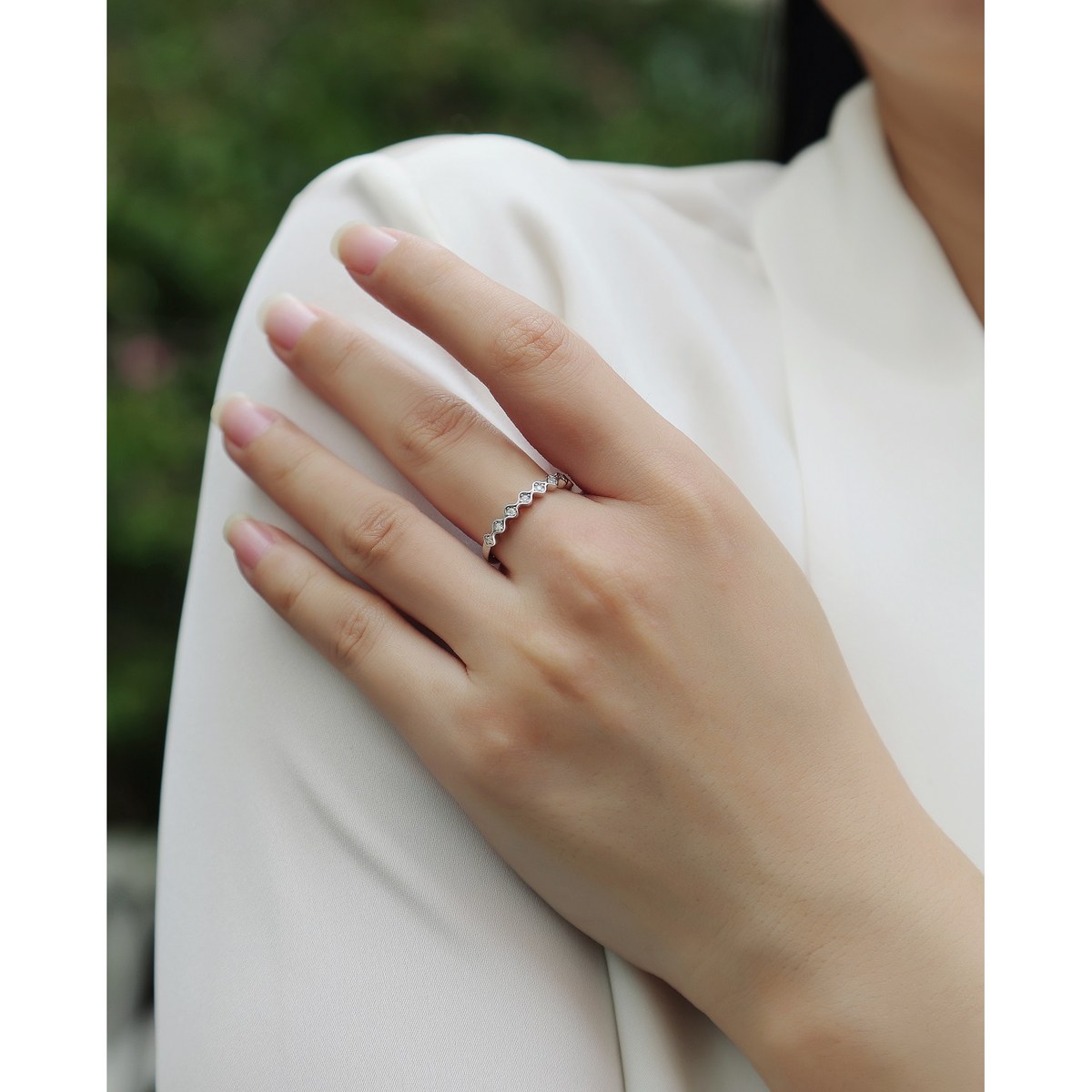
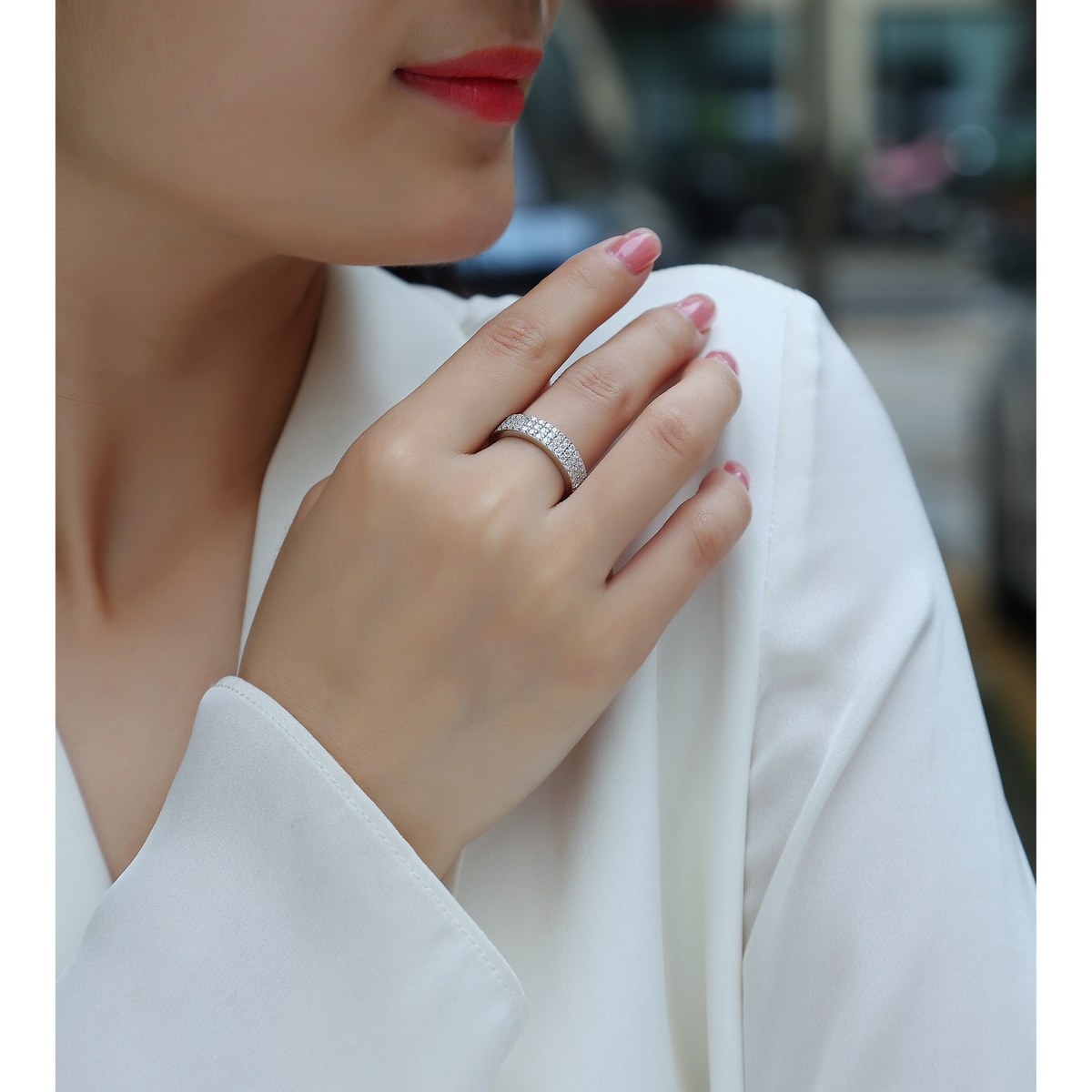
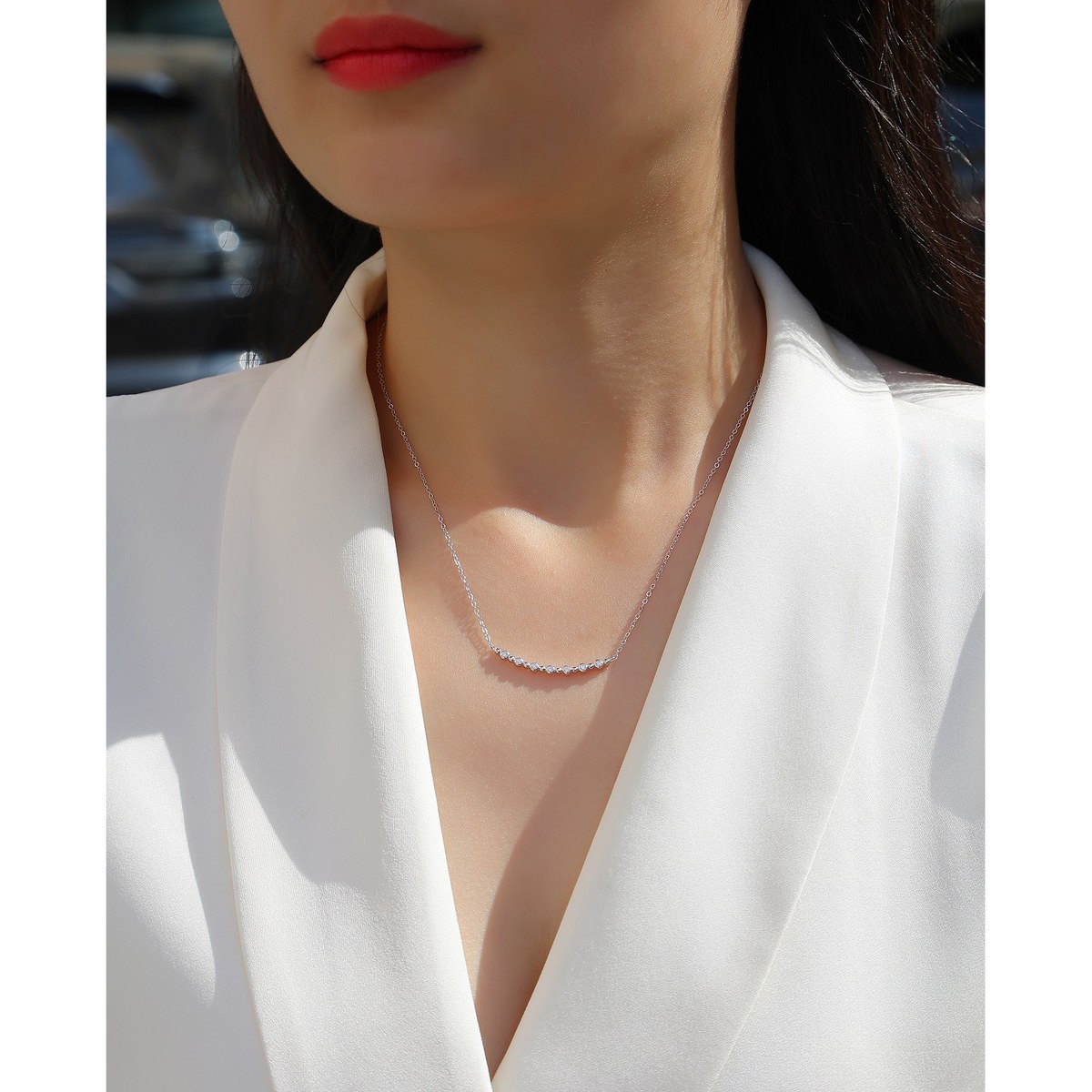
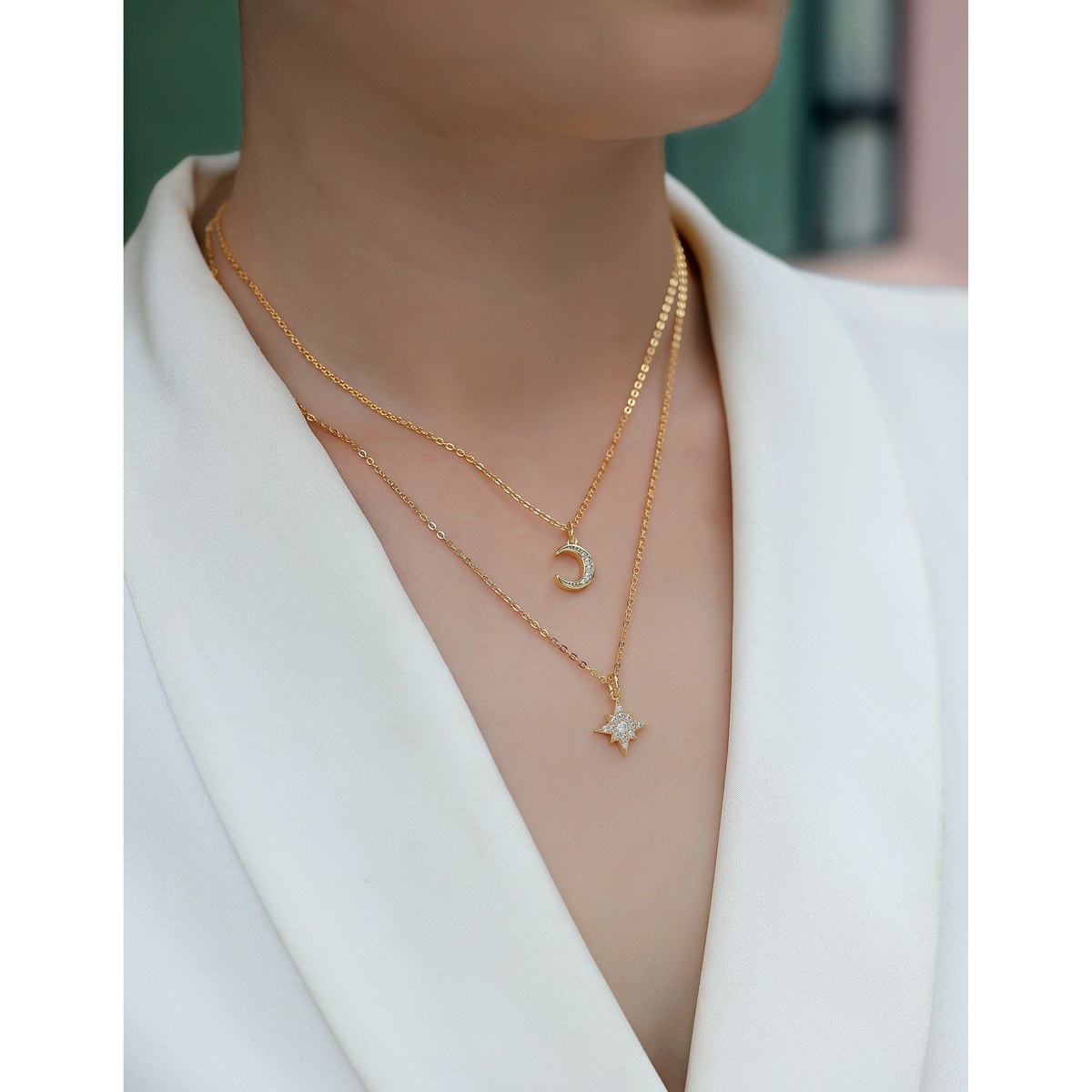
Too many silver jewelry listings stay vague about the details. Why is the stone set low? Why a silver post? Below is our reasoning for every piece we make — written plainly, and where we're not sure, we say so.
Rings
150 pieces
Mist Wave Ring · Mist and Water
In Chinese landscape painting, the part of the river painted least is often the water itself: a blank space, a few pale strokes, and the viewer fills in the rest. The ancients wrote of mist-waves on the river bringing sorrow — never for the water, but for the road you cannot see where water meets sky. This ring keeps that stretch of water at hand: the visible ripples and the invisible distance, on the same finger.
Ancient China was precise about circles and their gaps. A jade ring with a missing segment — a jue — was given at parting. A complete ring, huan, is a homophone for return: to give one was to say come back, however far you go. A band paved end to end with no empty stretch takes the second meaning — no gap, no parting, always a way home.
The ancients called bronze mirrors linghua - water-chestnut blossoms - because a flower was cast into the mirror's back, giving light a shape to land in. Light has no form of its own; the vessel lends it one. This ring is that flower: light enters the stone and comes back cut into facets of brightness.
Tao Yuanming wrote that clouds leave the mountain hollows without intent. The Chinese have always respected that mindlessness - not rushing anywhere, not anxious to become anything. This band of silver on the hand is a stretch of cloud that has made no plans.
Standing at the sea, Cao Cao wrote that the Milky Way blazed as if born from within it. To the ancients, light above and water below were one continuum. The point of light at your finger is that river's lower reach.
At the height of affection the ancients did not say love - they said the heart had been pledged, the way one pledges a wish. To depend on each other is not to be stuck together: each remains whole, and each stands witness for the other.
Too poor for lamp oil, the scholar Che Yin caught fireflies in a gauze pouch and read by them on summer nights. A faint glow still opens a page. Light is not about size; it is about whether you are willing to lean in.
The Daodejing says: soften the glare, join the dust. Not to disappear, but to stop blinding. Truly fine things never scramble to be seen - silver and stone each keeping its place is the whole lesson.
Bai Juyi wrote of trees whose boughs grow into one another, indistinguishable. Two linked rings are not bound fast; they have grown together. Each circle remains itself - only now, move one and the other knows.
The Song of the Yue Boatman goes: the mountain has trees, the trees have branches - my heart delights in you, yet you do not know. The first part is obvious; the second, unsaid. To love is to say the unsaid thing first.
In a Tang tale, Li Yuan and the monk Yuanze promise to meet in their next lives at Tianzhu Temple - and at the Three-Lives Stone, two people separated by death recognize each other again. The Chinese extend fate two lives back and two lives forward: luck across three lifetimes means a meeting was hard-won.
Traveling by night, Du Fu wrote: stars hang low, the plain runs wide. Stars and darkness complete each other - without night a star is only a point of light; without stars, night is only black. The things said under such a sky are not repeated by day.
Zhang Xian wrote that the heart is a net of double silk, knotted through and through. Interlacing is not tangle - every thread has a provenance. So it is with love: it cannot be sorted out, and you would not want it to be.
Ouyang Xiu: the moon climbs the willow tips; we meet after the yellow dusk. The best hour of the day is dusk - the day's business closed, the night's not yet arrived. A good moment is not a festival; it is this small gap where nothing is asked of you.
When Boya played, Ziqi listened. Boya thought of mountains; Ziqi heard mountains. He thought of rivers; Ziqi heard rivers. When Ziqi died, Boya smashed his qin. What truly stirs the strings is played only for someone who can hear it.
Du Mu wrote of ten miles of Yangzhou road, all in the spring wind. What is good about spring wind is that it plays no favourites - it stirs the wine banners and the patched coats alike. The poem's second half: no one behind the beaded curtains compares. Ten miles of spring wind, and still not you.
Zhuangzi opens with the great Peng bird, striking the water for three thousand li, riding the whirlwind ninety thousand li up - yet it has no cause to mock the quail hopping among the weeds. True freedom is not altitude: it is being at ease at any altitude. Wandering is your own affair, not a contest.
The ancients divided the eight solar terms from Minor Cold to Grain Rain into twenty-four pentads, each with its own flower - the twenty-four flower-tidings winds. The wind keeps its word: each pentad, one blossom opens. Flowers do not follow fashion; they keep appointments.
The Book of Songs gives the plainest picture of a good day: with qin and se at hand, all is quiet and well. Not that nothing happens - only that nothing happens without a place to settle. Quiet and whole is not the absence of events; it is every small thing coming to rest.
Chinese gifts come in pairs: two bowls, a couple of cups, even-numbered red envelopes. Odd numbers you keep; pairs you give - because a pair implies someone to share with. Two circles side by side carry that courtesy on the hand.
In the I Ching, the hexagram of Standstill is followed immediately by Peace - when the bad has run its course, the good is next in line. Extreme adversity returns to prosperity: this is not consolation but the order of the hexagrams. The turn of fortune is already en route while you are still at the bottom.
Where in life do paths not cross? An intersection, to the ancients, was never two lines brushing past - it is two threads woven into one fabric. Two lines cross at a point and each continues on; but from then on, that point belongs to both.
Cao Cao observed that when the moon is bright, the stars seem few. Yet the ancients loved a sky holding both - the moon's brightness never deletes the stars. The bright and the faint each shine their own; that is what makes a night sky.
Missing his younger brother, Du Fu wrote: the dew turns white from this night; the moon is brightest over home. Is the dew not white every night? Longing singles out one night and keeps it. Morning dew lives only until noon - because it is brief, it is worth seeing before the sun does.
The old almanacs promised a lucky star shining high - certain stars in heaven were charged with human fortune. To wear a star is to take that line out of the almanac and keep it at hand: it will shine when it is time to shine.
The Daodejing: the highest good is like water - it benefits all things and does not contend. Water's virtue is that it always takes the low road, yielding the high ground, yet nothing can stop it. Beneath the surge is the least hurried power there is.
Zhuangzi dreamed he was a butterfly, and on waking asked: did I dream the butterfly, or is the butterfly dreaming me? A parallel universe from two thousand years ago asks the same question - that beyond this you, another you may be living the other possibility.
The Daodejing says the greatest sound can barely be heard - not absent, only beneath the ear's threshold. Gentle words are spoken softly; the important movements come slow. The most moving bar of a piece is usually the quiet one.
The proverb holds that eight or nine of every ten things go wrong. That is what makes a fulfilled wish precious: granted as it was asked, no discount, no compromise. One round satisfaction deserves to be remembered with due ceremony.
Su Shi asked: I wonder what year it is tonight in the palaces of heaven. One revolution up there, and a year has passed below. At the top of the turn, the view is widest and the air is stillest. The wheel returns to where it started - the rider does not.
The Han oath Shang Ye is the fiercest vow in the old songs: only when mountains are levelled, rivers run dry, thunder rolls in winter, snow falls in summer, and heaven and earth merge - only then would I leave you. A vow, properly made, is a list of impossibilities.
The old saying goes: a seal is one's word. A document stamped carries something beyond ink - a person willing to answer for it. To wear a seal is to carry your own words with you.
Zhang Jiuling: the grass and trees have their own hearts - what do they care who picks them? A blossom opens because it must, not to be gathered. To grow wildly is to grow at your own tempo into your own shape; whether that pleases is someone else's affair.
At twenty, a young man's hair was bound and a cap set upon it; from that day he was addressed as an adult. A coronation is not a show for others - it is an announcement made to oneself: from today, my words and deeds count.
Zhang Sengyou painted dragons without eyes, warning they would fly away if dotted. No one believed him; he added two strokes, the wall split with thunder, and the dragons were gone. A whole painting may be fine - what people remember is the final stroke.
Shao-guang means spring light, and by extension every good season that will not stay. The ancients kept time not by clocks but by blossoms: at half-open, they knew to remember. Gathering light means picking it up while it is still there.
Nara Singde wrote: if only life stayed as it was at first meeting. It cannot - but the first glance can be kept in an object. Each time you see it, you return to that afternoon before any wrong word was said.
Zhuangzi opens with: in the Northern Darkness there is a fish, and its name is Kun. The northern sea is deep beyond sounding, deep enough to hold the largest fish. The good of a hidden deep is not the treasure it hoards - it is that everything finds room in it. Depth itself is a kind of strength.
A flower's fullest moment is not full bloom but the instant before it - every possibility still held in the fist. The ancients prized the yu, the 'about to': the moment of greatest promise is the one where nothing has been settled yet.
Chinese painting refuses to fill the page. Ma Yuan's lone angler occupies one corner; the rest is untouched paper - and yet you see the whole river. Blank space is not an unfinished painting; it is the part the viewer is trusted to finish.
The I Ching says: when two people are of one mind, their edge can cut metal. A bond looks soft, yet it is the toughest thing there is - much can stop one person alone; very little can stop two who move together.
Tao Yuanming's beans grew poorly, the weeds outpacing the shoots, yet all he said was: a wet sleeve is nothing, so long as the wish is not betrayed. To embrace yourself is to farm your own field, even at the cost of the harvest.
The Chan masters said: one moon prints itself on ten thousand rivers, and every river holds a complete moon. There is only one moon in the sky, yet countless in the water. Freedom is this - you need not climb to the sky; the river you stand in holds the whole moon too.
Yuan Mei wrote: the moss flowers, small as grains of rice, bloom anyway, like peonies. No bee comes to look; it opens all the same. Blooming is its own affair, and has nothing to do with being seen.
Two blossoms on a single lotus stalk the ancients called bingdi lotus, and counted it an omen of good. One root, two flowers - the good of twins is not growing identical, but drawing from the same source and opening in two directions.
Zhuo Wenjun wrote: I ask for a whole heart, and white hair undivided. What she wanted was not the finest person but the undivided one. The smaller the wish, the harder to grant - of all small wishes, 'undivided' is the dearest.
Xunzi said: the road is blocked and long - but if you walk, you will arrive. The worth of setting out is not speed; it is that once the direction is chosen, no other road is glanced at again.
Awaiting Return Ring · The Thread for the Traveler
Meng Jiao wrote: the thread in a mother's hand becomes the coat on the traveler's back. That stitch by stitch, sewn before departure, is not needlework but longing itself. To await a return means someone began waiting the moment you set out.
Li Bai wrote of a place beyond - peach blossoms and flowing water, a heaven that is not this human world. Another world need not be elsewhere: to live your days in the shape you love is to carve a not-of-this-world out of this world.
The Analects say: the pole star keeps its place, and all the stars turn toward it. What the stars attend is never the brightest one - it is the one whose place is surest.
Light and Shadow Ring · Sky-Light and Cloud-Shadows
Zhu Xi wrote: a half-acre pond opens like a mirror, and sky-light and cloud-shadow drift across it together. Half an acre of water holds the whole heavens. A small vessel does not necessarily hold a small view.
Zhuangzi tells of four friends who looked at one another and smiled, and from that became friends with nothing contrary between their hearts - the words never spoken were already understood. Real understanding needs no talk: to be known is at once the easiest and most extravagant thing in company.
In the Peony Pavilion, Du Liniang walks her garden into a dream, meets a scholar there, and wakes to live and die for that dream. Tang Xianzu wrote: love knows not where it rises, yet goes straight down deep. Some stirrings have no provenance - and run deeper than those that do.
Only at seventy did Confucius dare say: I follow my heart's desire without overstepping the line. To do as you please is not license - it is the freedom that comes when the rules have been absorbed into instinct.
The ancients called heaven, earth and the four directions the Six Harmony - together, the whole of the world. Six faces closing in hold the one point of light between them: to guard is not to block something out, but to enclose a place of calm.
Buddhism speaks of yuan-rong, round-blending: what is round has no corners to knock against the world; what blends excludes nothing, taking the shape of whatever vessel receives it. It is not the absence of principle - it is refusing to wound with one's edges.
The Daoists say the greatest way is utterly simple - the deepest truths fit in one sentence. Complexity is a skill; simplicity is the higher one. Remove everything excess, and what remains alone is what mattered.
The Book of Rites says: jade uncut never becomes a vessel. However fine the raw stone, without carving it stays a stone. The grinding hurts - but every warm inch of jade's lustre was bought with those strokes. Everything fine passes through this, people included.
Seeing a friend off at Weicheng, Wang Wei urged one more cup of wine - west of the Yang Pass, no old friends remain. Yet that very line has kept the pass warm for a thousand years: a desolate place, so long as someone remembers you there, is not desolate.
Li Qingzhao wrote: the setting sun melts like gold, the evening clouds close like joined jade discs. In the day's most magnificent ten minutes the ancients coined a phrase - only when the light is about to leave does it spend its whole treasury of colour.
The Book of Songs sings: endless spreads the vine along the river's edge. The vine's virtue is that it never asks about its starting point - give it one stretch of bank, and it will grow into an expanse.
The ancients read the seasons from the Dipper's handle: when it points east, spring comes to all under heaven. The stars revolve and the seasons change - turning is not being lost; turning is order itself. The position it returns to is called a season.
Li Qingzhao wrote: the star-river seems to turn, a thousand sails dancing. The river above and the rivers below live by the same law - only what flows is a river; what stands still is merely water.
In Tao Yuanming's tale a fisherman stumbles into the Peach Blossom Spring, and though he marks the way at every turn on leaving, he never finds it again. The good of a wonderland lies precisely in the stumbling: a place you set out to find is a tourist spot; only the one you blunder into is paradise.
Flowers in the mirror, the moon in water - the Buddhists used them for illusion: visible, ungraspable. Yet the ancients loved the phrase all the same: precisely because it cannot be kept, it is looked at all the more closely. A phantom owes you nothing; having been beautiful, it was real.
The oldest starlit night in the Book of Songs: bundled firewood, three stars aloft - what night is this, that I meet this good person? A sky full of stars is only the backdrop; what matters is that tonight the one you hoped to see was met. A sky full of whispered stars has only ever had one listener.
Zhuangzi says a life between heaven and earth is like a white colt flashing past a crack in the wall - sudden, and no more. Time moves like a dancer's turn: because none of it can be kept, every phrase of the dance must be danced whole.
The judgment on the first hexagram of the I Ching: the heavens move with vigour; the noble one strives without rest. The turning heavens have not stopped for an eternity - 'without rest' does not mean strained effort; it means taking 'continue' as one's nature, as heaven does.
Climbing the Youzhou terrace, Chen Zi'ang wrote: I think of heaven and earth, endless, and alone I weep. Heaven and earth so long, so vast; a person so small. Yet turn it over: in the very instant one is aware of one's smallness, one is largest.
In the Peacock Flies Southeast, Liu Lanzhi vows: be you the bedrock, I the reed. The bedrock does not move; the reed is tough as silk. The surest support has never been how tightly it holds - it is that, standing there, it goes on standing there.
The pearl on the palm began as Fu Xuan's praise - a pearl carried in the hand, one its owner could not bear to drop. To be treasured is not to be worth much; it is that someone holds you like a pearl, handling even your ordinary parts with care.
The Sayings of Confucius tell us: the orchid that grows in the deep woods is no less fragrant for the absence of admirers. The orchid blooms unseen and is fragrant still - fragrance is its nature, not its performance. True fragrance has nothing to do with an audience.
In Zhuangzi's Autumn Floods, the River God swells with pride until he meets the sea - and learns how small he is. When the autumn waters rise, everything looks grand, right up to the moment the sea appears. The gift of experience is the courage to admit: so there was something larger.
Su Shi and his friends boated at Red Cliff and talked till dawn - they did not notice the east growing light. However long the night, good company shortens it; by the time you notice the sky, it is already morning. The best hours are all like this: only at their end do you notice they happened.
Zengzi said: the load is heavy and the road is long. The heavier the burden, the steadier the pace must be. Whatever bears real weight wears the plainest face - for ornament is for others to see; steadiness is what you yourself will use for a lifetime.
Li Shangyin wrote: when shall we trim the candle together at the west window, and talk of this night's rain in the Ba hills? Separated by rain tonight, he draws the future reunion in advance - missing someone down to planning what you will discuss when you meet.
The Analects say: only when the year turns cold do we learn that pine and cypress are the last to fade. The brambles have gone brown; the pine is still green. That is what a trial is for: green in fair weather counts for little; green after frost is the real thing.
The carp of the Yellow River swims against the current; clear the Dragon Gate and it becomes a dragon. The ancients carved that leap above their doorways for exam-takers, merchants and travellers to glance at on the way out. Whether you clear the gate is one question; daring to swim against the stream is another.
Zhang Ruoxu, on a spring river beneath the flower-and-moon night: river and sky one colour, without a speck of dust; alone in the bright air, a single wheel of moon. At night the water and heavens merge into one seamless colour. The cleanest vastness is the kind that needs no dividing line.
Wang Bo wrote: the poorer the strait, the firmer the will - never let the azure-cloud resolve fall. The clouds stand high, the person stands low; what lies between is not distance, but the willingness to keep the chin lifted.
The Dao De Jing says: the highest good is like water - it benefits all things and contends with none. Water helps everything along, then takes the lowest place for itself. Fighting upstream is instinct; taking the lower seat is cultivation.
Mingled Light Ring · Soften the Light, Join the Dust
The Dao De Jing says: soften the light, join the dust. Not unlit - lit without glare. Those who truly carry light never hold themselves up like a lamp in everyone's eyes.
Wen Tingyun wrote: a red bean set into the dice - do you know the longing that reaches the bone? Words spoken aloud are all light ones; the sentence never said is the heavy one.
The Dao De Jing says: the greatest skill looks like clumsiness. The maker buries his craft where no one can see, leaving only evenness on the surface. What shows off is technique; what hides itself is mastery.
Yang Wanli wrote: the little lotus has only just shown its pointed tip, and already a dragonfly stands upon it. Before the flower opens, the good news has arrived. The finest moments in life are all 'only just' - everything still ahead.
The Book of Songs describes the peach blossom as zhuo zhuo - not a colour word but a burning one. Flowers from three thousand years ago are still hot to the touch. What is truly beautiful cannot be burnt away by time.
The Records of the Historian tell of Ji Bu: a hundred catties of gold is worth less than one of his promises. A word outweighs gold because, once given, it can never be taken back.
Su Shi wrote: skin of ice and bone of jade, cool by nature even at summer's height. The ancients called such cleanness 'jade bones' - the weather outside never reaches the inside.
Du Fu wrote: stars hang low over the wide plain; the moon surges and the great river runs. Only with stars hanging low is the plain so vast; only with the moon heaving is the river alive. Vastness is not the absence of edges - it is having something to mark them by.
The Huainanzi says: the hundred rivers rise from different springs, and all return to the same sea. Every river has its own point of departure; they end in one water. People, too, take different roads - they need not share yours.
Liu Yuxi wrote: since ancient times autumn has been met with sorrow - yet I say the autumn day outshines the spring dawn. While everyone grieves the falling leaves, he declares autumn the better season. A flower that opens in autumn need not compete with spring's noise.
The Book of Songs says: I think of that noble one, warm as jade. The goodness of jade is its warmth - never hot to the hand, never cold, but exactly the kindness that is just right.
Su Shi wrote: the truest flavour in this world is qing huan - plain, quiet gladness. After all the strong and fiery tastes, the signature at the bottom is the mild one. Qing huan is tea, not wine: it does not intoxicate, and you can drink it for a lifetime.
The Book of Songs asks: now that I have seen my beloved, how could I not be glad? A heartbeat from two thousand years ago, candid as a child's - joy, stated without a single ornament.
Li Bai wrote: the day will come to ride the long wind and break the waves - hoist the cloud-sail straight and cross the deep sea. The wind and waves are certain; when they come, let the sail out full. Optimism is not denying the storm; it is treating the storm as the road.
The Dao De Jing says: open as a valley. The valley is the truly spacious thing - it can hold everything and hoard nothing. A great heart is measured not by how much it holds, but by how much it can stay empty for.
Li Bai wrote: the tower rises a hundred feet; I could reach out and pluck the stars. One should have had an age of wanting to pick stars - it is what makes the life on the ground bearable after.
Emperor Xuanzong pointed to a blossom among his court and said: how can it compare with my flower that understands words. A flower that speaks is one that knows when to stay silent. Beauty is a gift; understanding is a cultivation.
Plum and Crane Ring · Plum for Wife, Crane for Son
Lin Bu retired to Solitary Hill, never marrying and never taking office, raising plum trees and a crane. People called it 'plum for wife, crane for son'. To live one's days in the shape one loves is also an accomplishment.
The Book of Songs: the moon rises, so bright - and the beautiful one grows lovelier still. Most of the loves in the Songs happen by moonlight; the daytime world is too loud for them.
Su Wei-dao wrote of the Lantern Festival night: trees of fire and flowers of silver close in from every side. One night a year, the ancients lit the whole city until the trees burned gold and the ground ran silver - a galaxy brought down to earth.
In the Buddhist sutras the udumbara flower opens once in three thousand years, at night, for a single instant. Brevity is not the regret - because it blooms only an instant, to have seen it at all is fate.
The Dao De Jing says: see the plain silk, hold the uncarved wood; let the self be small, the wants few. Pu is the log before the carpenter's plane - and every refinement should set out from it.
Sun Kang of the Jin was too poor for lamp oil, and read on winter nights by the light the snow reflected. Snow makes no light of its own; it only stores the sky's light and hands it back to those in the dark. Gentle strength works this way - creating nothing, passing everything on.
Xunzi said: indigo is drawn from the blue plant, yet is bluer than the plant itself. That is the whole point of inheritance - not to copy what came before, but to go one shade deeper.
The Book of Songs says: stones from other hills may polish jade. However fine, jade cannot grind itself; however strong, a person still needs a stone from another hill.
The Book of Songs likens the gentleman to a worked thing - cut and filed, carved and ground. Bone is cut, ivory filed, jade carved, stone ground: no shortcut exists in slow crafts. Polishing oneself gentle is the same trade as polishing jade.
Dragon's Pearl Ring · The Pearl Beneath the Dragon
Zhuangzi tells of a man who dove into the ninefold deep and took the pearl from beneath the black dragon's chin. The finest things sleep in deep water, and few dare go down - which is why pearls cost what they do.
The Book of Songs blesses: may your years be like the Southern Mountain - never worn away, never falling. When the ancients wished long life they did not name numbers; they named a mountain.
Cao Cao wrote: the sun and moon on their journeys seem to rise and set within it - within the sea he stands before. A heart that can hold the sun and moon makes an ocean feel like a courtyard.
The Dao De Jing says: the greatest vessel is the last to be finished. The small pieces come fast; the heavy ones take time. When a tree has not flowered, it is busy growing roots.
Li Bai wrote: clouds recall her robes, flowers recall her face. The highest beauty works this way - it turns everything else in the world into a reminder.
The Book of Songs says: the crane cries from the deepest marsh, and its voice is heard in heaven. Calling from a low place never kept a voice from the heights.
Tao Yuanming wrote: up at dawn to clear the weeds, home at moonrise with hoe on shoulder. He made labour sound like poetry: with a moon over the road home, no day counts as hard.
Su Shi wrote: drifting, as if the world were left behind - feathered and ascending. Breaking the cocoon is not escape; it is finally growing the wings the sky deserves.
Confucius said that virtue is like the pole star: it stays in its place, and all the stars turn around it. A six-prong setting works the same way - six small claws hold the stone from every side, each one a supporting actor to the light at the centre. Good things do not announce themselves; hold steady, and everything else will arrange itself around you.
Confucius said that virtue is like the pole star: it stays in its place, and all the stars turn around it. A six-prong setting works the same way - six small claws hold the stone from every side, each one a supporting actor to the light at the centre. Good things do not announce themselves; hold steady, and everything else will arrange itself around you.
Climbing Mount Tai, Li Bai wrote that from the halfway wall of the peak he already saw the sun rise out of the sea, and heard the celestial rooster cry mid-air. Halfway is not a shortfall - it is exactly the right place to stand: no need to reach the summit before the light arrives. This ring gives half its world to silver and half to stone, and between them the whole landscape completes itself.
In her Song of White Hair, Zhuo Wenjun wished for one devoted heart that would not part until the hair turned white. The old poets did not trust sparks; they trusted duration - the long ordinary of growing old side by side. This ring was not made for a highlight. It was made for countless unremarkable mornings.
The 'bright pearl in the palm' is the one held dearest. Bai Juyi wrote of his three-year-old daughter as a single pearl in his hand - the picture of someone precious not because rare, but because of where she was placed. To cherish is a matter of position. This ring sets that pearl as close to the hand as it can be.
Moon Over the West Tower Ring · Moon Over the West Tower
Li Qingzhao watched the wild geese return in formation while moonlight filled the little west tower to its edges. Fullness is not crowding - it is light arriving where it should, leaving no corner unattended. A ring paved all the way around learns precisely this generosity from the moon.
When the Chinese say 'flowers at their best, moon at its roundest,' they mean the moment when everything simply arrives at its own hour - not the costliest flower, not the brightest moon. A circle is not the absence of a gap; it is the gap turned to the side no one sees. May this round ring keep the day when your hour came.
Du Fu described the beauties of spring 'gathering kingfisher feathers, exchanging greetings in the season' - stooping into the deepest grass to pick up what shimmered, and giving it away as spring. To gather is a bent-down tenderness: not owning the best, only picking up what lights you. May this ring help you stoop, now and then, for the light in ordinary days.
Wang Changling sent word that his heart was 'a piece of ice in a pot of jade' - transparent, cool, and unclouded by whatever passed through it. The heart-cut stone here is not for sweetness alone; it is a reminder that the first intention was clean and clear, and worth keeping exactly as it was.
The old saying goes: let the mind be round, but let conduct be square. Squareness is the edge that does not tilt or blur. This bezel-set ring seats its stone within four honest borders - however smooth the world becomes, keep a little squareness at your finger, and you will not lose your shape.
The old saying goes: let the mind be round, but let conduct be square. Squareness is the edge that does not tilt or blur. This bezel-set ring seats its stone within four honest borders - however smooth the world becomes, keep a little squareness at your finger, and you will not lose your shape.
The ancients called the heart 'a square inch of ground' - an inch across, yet roomy enough for heaven and earth. This little sugar-loaf ring carries not a single pavé stone, only one highly polished plane: clean your square inch, and the light will come on its own.
A Grain of the Vast Sea Ring · A Grain of the Vast Sea
On the river at Red Cliff, Su Shi sighed that we are mayflies between heaven and earth, a single grain in the vast sea. A grain of rice barely exists before the ocean - yet it is exactly this grain that gives 'vast' its meaning. One small sugar-cut stone: a reminder of humility, and that even the sea is measured grain by grain.
The heaviest vow in the old ballads calls heaven and earth to witness: not until the mountains are levelled, the rivers run dry, thunder rolls in winter, snow falls in summer, and sky and earth merge - only then may we part. A true vow is never light. It first admits how heavy the world is, then sets itself upon it.
The heaviest vow in the old ballads calls heaven and earth to witness: not until the mountains are levelled, the rivers run dry, thunder rolls in winter, snow falls in summer, and sky and earth merge - only then may we part. A true vow is never light. It first admits how heavy the world is, then sets itself upon it.
To praise a beauty, the ancients said her brows were like distant hills - never heavily painted, just a pale, rising line of green. The virtue of faraway hills is distance: you see the silhouette, never the detail, so they never tire the eye. A marquise stone is exactly that brow - a small lift at each tip, an unhurried arc between.
Mencius spoke of raw jade as 'whole, formed by heaven itself' - a stone outside, a hidden order within. An oval-cut stone is uncut jade brought to a polish: it does not chase the sharpness of facets, but lets the curve speak. To be told 'formed by heaven' is a higher compliment than to be called well-carved.
The Book of Songs needed only eight characters for a beauty: 'her artful smile so dimpled, her beautiful eyes so clear.' Nothing about their shape or craft - only the instant the glance turns. That turn is light caught alive. A marquise stone tapers to a point at each end, the way a look gathers before it is given. May whoever wears it keep that turn in her eyes.
A phoenix crown was worn once in a lifetime - on the wedding day, beads strung beneath golden wings, every step catching light. A crown was never for onlookers; it gave the wearer one certain moment: today, you are treated with ceremony. This small crown hands that moment back to you, on any day you choose.
One Vow for Life Ring · Through Parting and Meeting
The Book of Songs counts the cost before it vows: 'In death or life, in meeting or parting, I made my pact with you. I take your hand, and we grow old together.' Parting and meeting - the pact was not spoken under a perfect moon, but with all the partings already priced in. True love is true because its terms include every hard clause.
Yu Liangshi wrote: 'Scoop up the water, and the moon is in your hands; brush past the flowers, and their scent fills your sleeves.' The moon was never out of reach - we only kept trying to pluck it and forgot to scoop. Some things need not be owned; bend down and lift a handful of water, and it is yours.
Moved by his friend's devotion, Li Bai wrote that the Peach Blossom Pool ran a thousand fathoms deep, yet not as deep as the love Wang Lun sent him off with. The pool can be sounded; the friendship cannot. A large stone is the same - what meets the eye is the carat; what holds the room is the intention behind it.
The Book of Songs promises blessing from heaven, and nothing but good fortune to follow. The ancients believed a star kept watch over each of them. Luck, though, is a verb: the star must find you, and you must still step out and stand in its light. May this ring be that star - and a reminder not to waste its shine.
The Book of Songs promises blessing from heaven, and nothing but good fortune to follow. The ancients believed a star kept watch over each of them. Luck, though, is a verb: the star must find you, and you must still step out and stand in its light. May this ring be that star - and a reminder not to waste its shine.
The Book of Songs promises blessing from heaven, and nothing but good fortune to follow. The ancients believed a star kept watch over each of them. Luck, though, is a verb: the star must find you, and you must still step out and stand in its light. May this ring be that star - and a reminder not to waste its shine.
Tao Yuanming wrote a poem called 'Paused Clouds': thick clouds hanging still, a fine slow rain falling - the poem, he noted, was for missing dear friends. Stopping the clouds is how longing works, and how remembrance works: take the best moment, suspend it mid-air, and do not let it leave.
Fan Zhongyan described Lake Dongting: 'Floating light leaps like gold; the still shadow sinks like a sunken jade.' The same moonlight - dancing gold on the surface, a weight of jade in the deep. May your fast days keep the sparkle of floating light, and your slow days hold the gravity of sunken jade.
The ancients sealed love not with diamonds but with knots - two cords tied into one that could not, and need not, be undone. Emperor Wu of Liang wrote of the double silk sash at his waist, braided in dreams into a true-lover's knot: worn by day, rewoven by night. A lock and a knot mean the same thing: not captivity, but two wills willingly tangled into one shape.
The Book of Songs catches the disbelief of a wedding night: 'What evening is this, that I should meet this good man?' - joy so great it doubts the hour itself. Meeting the right one feels exactly like this: first you suspect the night is not real; then you decide that if it is a dream, you are not going to wake.
An oath in the Book of Songs ends with the strongest notarisation available: 'If you do not believe me, let the bright sun be my witness.' The sun was the ancients' notary - everything brought into broad daylight, no shadow left to hide in. May this ring be your bright sun: open in its shine, able to stand inspection at noon.
Wang Bo wrote of seasons slipping past while 'things change and stars shift their places.' The turning of the stars sounds melancholy, but it is the most punctual thing the universe does: everything moves, nothing falls into disorder. A life's orbit is the same - the detours look long, yet every step stays on its own track.
Qu Yuan lamented in the Songs of Chu: 'Fine jade at my breast, gems in my fist - and no one to show them to.' Holding fine jade became an idiom for worth that needs no audience: carried quietly, it weighs what it weighs. A vintage form pursues exactly this - the kind of richness that never raises its voice.
Cao Fu described the goddess of the Luo river as 'graceful as a startled swan, sinuous as a swimming dragon' - a wild goose skimming the water, beautiful precisely because it cannot stay. Lu You later wrote of the startled swan's reflection with the same ache: some beauty is granted only an instant, and that is why everyone who sees it remembers.
White Moon Star Necklace · A Thousand Rivers, One Moon
There is a Chan saying: a thousand rivers hold a thousand moons. The moon is one, but wherever the water is still, a full reflection appears. The ancients entrusted longing to it — a thousand miles apart, we share this single moon. Two people far from each other look up at the same one. This necklace takes that moon, and its company of stars, down to a distance you can see by looking down.
When the Chinese looked at the Milky Way they did not see a galaxy — they saw a river: the one that keeps the Weaver Girl from the Cowherd. Once a year, on the seventh night of the seventh month, magpies bridge it so the two can cross. So the Milky Way in China was never astronomy; it was distance, and reunion. A whisper is a sentence handed to the farthest thing you know. This chain hangs that unfinished sentence over the water, word by word.
Mencius: the great person is one who does not lose the newborn's heart. The more you have seen, the more of that first innocence you must keep - it does not solve problems; it reminds you why you set out.
Yuan Haowen asked: what is love, that it makes people pledge each other this life and the next? To invoke love is to stake your own name on it. The ancients did not pledge lightly, and once pledged it counted - there was no notary then, only heaven as witness.
Wang Wei: red beans grow in the south; how many branches sprout this spring? Gather a few to keep - nothing longs harder. When longing could not be spoken, a red bean was sent. The old way of loving was roundabout: the wider the detour, the deeper the missing.
The Chu proverb ran: a hundred catties of gold are worth less than one promise from Ji Bu. A promise worth a thousand gold is no exaggeration - a promise kept appreciates better than anything.
The loudest of the solar terms: spring thunder cracks, and every hibernating thing is startled awake. The I Ching says all things emerge from Thunder. The year's vitality is summoned by a single clap.
Li Shangyin: we lack the wings to fly side by side; our hearts are joined like the rhino's single thread. Through the rhinoceros horn runs one continuous vein - two hearts so joined need no words. Understanding is not guessing right; it is one thought lighting up in two places at once.
On a boat at Red Cliff, Su Shi consoled his guest: only the river breeze and the mountain moon - none may forbid you to take them, and they will never run out. The best things are free. The breeze does not check your clothes; dancing with it requires no steps.
Of the solar terms, Minor Heat has its Major Heat, Minor Snow its Major Snow - but after Lesser Fullness there is no Greater Fullness. The ancients refused to spend full. Grain fills but does not burst; unripe is exactly right. The best station in life should be this one.
The Nineteen Old Poems: far, far, the Cowherd star; bright, bright, the Weaver girl. Two people across the galaxy meet once a year and miss each other for the rest. A love between stars means: distance is not the problem; not missing each other would be.
The Book of Songs: the reeds are grey; white dew turns to frost. The one I speak of is somewhere across the water. White Dew is autumn's first name, and the first day of missing someone.
Rain births the hundred grains. The last term of spring: only when the rain has been sufficient do the seedlings dare to grow. Grain Rain is not weather; it is the crop's rations. Rain that falls at the right time outvalues anything.
Liu Yuxi: sun in the east, rain in the west - no sunshine, they say, yet sunshine all along. The word for clear hides the word for love; the old messages were never spoken outright. What is said is weather; what is meant is the message. A whisper is for whoever understands it.
The Warring States phrase: return to the uncut and the true - filing away the marks of carving until one is unworked again. The pu is a stone with jade inside: uncut, no one knows what is in there, itself included. Sincerity means: no posture.
The idiom: swallowing what must be swallowed as though it were syrup. Frost on a pastry is the thinnest layer: sweetness shows best when it is not the majority. A life needs returning sweetness, and for that, a slightly bitter base.
The yingluo is the necklace of the bodhisattvas - strung beads and jade falling in tiers. It crossed into the secular world by Tang times; Bai Juyi dressed Yang Guifei in cloud hair, flower face, golden shake-steps. The beauty of a tassel is that it moves: when you walk, the light walks too.
The Classic of Mountains and Seas records over five hundred mountains and three hundred waterways - and singing fish, and nine-tailed foxes. It was China's first atlas and its most honest one: the world is vast, no one has seen it all, so draw in everything you have heard. To wear mountains and seas at the chest is to admit the world is large - and that you mean to go.
From the Image of the Kun hexagram: the earth's condition is receptive devotion; the noble one carries all things with abundant virtue. The earth discriminates against nothing and carries everything. Thickness is not heaviness but capacity: the good and the bad are set on it, and the crops grow regardless.
The ancients named the region around the pole star the Purple Palace - the seat of the Celestial Emperor, about which all other stars wheel. The king of stars is not the brightest; it is the one that does not move. The Dipper steers by it.
Not knowing refraction, the ancients said the rainbow was a dragon drinking - its tail dipped into the river. Everything named for the rainbow was auspicious: the rain finished, the light itself came out to tidy up, and built you a bridge to watch.
Before script, the ancients kept records by knotting cord - a large knot for large matters, a small knot for small. On one cord hung everything that mattered. A brocade cord adds fortune: knot the good things too, tie them at the neck, and do not let them come loose.
Wild Goose Pagoda Necklace · Names on the Wild Goose Pagoda
A new Tang jinshi climbed the Wild Goose Pagoda in Chang'an and wrote his name into it. Bai Juyi, passing at twenty-seven, boasted: among the seventeen names, mine the youngest. The point of an honour is not the glory but the moment of the inscription - I came, I achieved, I was recorded.
Diamond Heart Necklace · A Heart of Ice in a Jade Pot
Wang Changling wrote: if friends in Luoyang ask after me, tell them - one chip of ice, clean in a jade pot. To pass through the world's affairs and come out still clean: that is the most dignified answer one can send.
Lifetime Shine Necklace · Through Death and Distance
The heaviest vow in the Book of Songs: in death and in distance, in the compact between us, I gave you my word - I take your hand, and we grow old together. A lifetime's promise does not rest on luck; it rests on taking the words 'as agreed' seriously.
Converging Stars Necklace · The Stars in Their Stations
The Thousand Character Classic opens with heaven and earth: sun and moon rise and set; the stars spread each in its place. The sky's serenity is every star keeping to its station - not snatching another's light, nor putting out its own.
The Tang line goes: from this floating life I steal half a day of ease. Ease is not something you wait for - it is stolen from a full schedule. Only the stolen is precious: that half-day of loosened hours is more yourself than half a month of busy ones.
Lu Zhaolin wrote: I would be a mandarin duck and envy no immortal. Immortals live long; mandarin ducks live warm - length belongs to the immortals; warmth belongs to us.
Resigning his post, Tao Yuanming wrote: long in the caged coop, I return again to nature. Only stepping back into the woods after years in a cage tells you what ease is. 'Natural' is not a place - it is the way of living that requires no performance.
Afternoon Rose Necklace · Fragrance Farther, Purer
Zhou Dunyi loved the lotus: the farther its fragrance carries, the purer it grows; it stands clean and upright. A good scent does not fear distance, and good character does not fear scrutiny: only what stays fine at a distance earns the word pure.
The Han songs sing: a guest come from afar brings me twin carp; call the boy to cut them open - inside, a letter of white silk. Letters were cased in fish-shaped boxes, so opening mail was like opening a fish. The oldest romance: hiding the words you mean inside a fish, and sending it over a thousand rivers.
Legend says the jiao-folk of the southern sea weep pearls - tears that fall into the shell become pearls. The most precious pearls are not gathered but wept: the crying dries, and the part that turned to pearl remains. The deeply feeling waste not even their tears.
In the Yellow River's rush there stands a stone islet that no flood has moved - the Pillar in Mid-Stream. An anchor does not take every blow for you; it lets you know this: however high the water, behind you is one stone that will not shift.
In a Tang tale the old man under the moon ties a red thread between the feet of fated mates - once tied, no feud, no distance can undo it. The thread is invisible, but knotted it cannot slip: fate works like that - soundless, and the strongest cord there is.
Orchid Girdle Necklace · Threading Orchids for a Girdle
Qu Yuan wrote: I thread autumn orchids to wear at my waist. Herbs worn as ornaments are one's integrity carried on the body: the noble one wears character the way others wear jewels - to take it off would be to look less like oneself.
The New History of the Tang called Di Renjie a pearl the vast sea had overlooked - talent passed by. A pearl under sand is not misfortune but timing: the pearl is still a pearl, the light its own; sooner or later someone kneels down and knows it in the sand.
On the loom the lengthwise threads are the warp, the crosswise the weft; a bolt of cloth is where they interlace. From this comes 'warping heaven and weaving earth' - the stars each keep their path, crossing into order. Interlacing is not tangling: every thread keeps to its own line, and only so is the whole cloth woven.
Stacked Stars Necklace · Morning Star, Evening Star
The Book of Songs records: in the east, Qiming, herald of dawn; in the west, Changgeng, lamp of dusk - and they are one and the same planet. One star, two names, two hours. Those who understand know: the lamp that sees you home at night and the lamp that sees you off at dawn are a single light.
The Book of Documents lists life's five blessings: long life, means, health and peace, love of virtue, and a fitting end. A wish need not be grand - no one holds all five at once; to keep even one or two securely is already a good fate.
Jade in Bosom Necklace · Jade in Bosom, Jade in Hand
The Songs of Chu praise one who carries jade in his bosom and holds jade in his hand - taking it wherever he goes. Real wealth is not in the treasury but on the person: skill and character carried in the bosom travel better than anything.
Before heaven and earth were parted, the undivided breath of chaos was called hongmeng - no light had yet been born, yet everything was already in it. Chaos is not nothing; it is everything not yet begun: every light there ever was came out of that mist.
Floating World Necklace · This Floating Life, A Dream
Feasting one spring night, Li Bai wrote: this floating life is like a dream - how many hours for joy? And then, the very next line, he lights the candles and feasts on into the night. Precisely because it is a dream, one lights the lamp and sees the dream through.
The Book of Songs says: the qin and se are at hand, and everything is calm and good. The finest life is not somewhere far off - it lives in those three words, 'at hand': within reach of the arm.
Standing by a river, Confucius said: it passes like this, never resting day or night. Seeing time flow is not sorrow but clarity - which is why this very moment is worth so much.
Li Bai wrote: on Yan Mountain the snowflakes fall as large as sleeping-mats. When northern snow reaches its fullest, a single flake could seat a man. Hyperbole is a poet's honesty - anyone truly astonished has said something untrue.
Bai Juyi wrote: when spring comes, the river runs green as indigo - deeper than the plant that dyes it. What he missed most was not scenery but this colour: the things worth a lifetime of remembering are often only a colour.
Cha Shenxing wrote: in a moonless dark, a single fishing lamp - one mote of light, a firefly on the water. The darker the night, the more one small light seems like the whole world.
The Book of Songs says: the high mountain - one looks up to it; the great road - one walks it. Both reverence and longing are things that lift the head.
Fan Chengda wrote: may I be the star and you the moon - nightly, each shedding light, each polishing the other. The finest kind of bond: shining together, never stuck together.
Li Bai wrote: the cataract plunges three thousand feet - as if the Silver River itself were falling from the ninth heaven. The only way to say a marvel correctly is to borrow a bigger marvel for the comparison.
The Book of Songs says: you threw me a peach; I return you fine jade. Not a fair trade - a gift's worth lies in the heart behind it, and hearts cannot be weighed.
The Book of Songs describes a gentleman with jade ear-pendants bright as stars at his cap-strings. The ancients made 'decorum' into something you could wear.
A New Account of the Tales of the World notes: clear dew flows at morning; the new paulownia leaves are just uncurling. Good days are not hard to find - with the right eyes, every morning holds a newly opened leaf.
From Notes at a Quiet Window: unmoved by favour or disgrace, idly watching the courtyard flowers open and fall; indifferent to going or staying, drifting along with clouds furling and unfurling beyond the sky. The highest letting-go is watching heaven the way one watches one's own garden.
Du Fu wrote: stars hang low over the vast plain; the moon surges with the great river's flow. The water moves; the light is still - one moving, one still, and so the line has lasted a thousand years.
The Book of Songs says: Zhou is an ancient state - its mandate, ever new. Old and new are not enemies: only things old enough are worthy of constant renewal.
Priceless Jade Necklace · The Jade Inside the Stone
Bian He offered his uncut stone three times; two kings of Chu took him for a fraud and a foot was cut off each time. When the stone was finally opened, it held the finest jade under heaven. Until it is recognised, every true treasure is only a rock.
The Han ballad Lord Above! swears an oath: only when mountains lose their peaks, rivers run dry, thunder rolls in winter, snow falls in summer, and heaven and earth close together - only then would I leave you. The ancients wrote love-letters by first listing the impossible things.
Linked Rings Necklace · The Bird That Carried a Ring
Legend tells of a yellow bird that carried a jade ring to repay the man who saved its life - the ancients called it 'knotting grass and carrying rings'. Kindness does come back; it simply never takes the same road home.
Zhuangzi dreamed he was a butterfly; waking, he could not tell whether Zhuang Zhou had dreamed the butterfly, or the butterfly was now dreaming Zhuang Zhou. To lose track of which world is real, now and then, only proves you have lived both in earnest.
Wang Qi wrote that when the tumi rose opens, the season of flowers is over - it blooms last, and spring closes behind it. Yet the Song poets loved it for exactly that: blooming at the end, it spends the whole spring's strength on a single flower. An afternoon rose does the same - it misses the morning dew, and keeps its own unhurried scent.
A letter in old China ended with a seal pressed in vermilion - proof of the word, and a mark that says 'I was here.' Two hearts beating as one is literally 'hearts pressing the same seal': each can read the other's lines. The small light this necklace drops at the collarbone is that seal - love was here, let this stand as witness.
Wang Wei wrote: 'Red beans grow in the southern land; how many branches sprout each spring? Gather plenty, my friend - nothing longs for you like these.' The red bean is the longing-bean, its skin a deep red that never fades with time. The ancients sent no long letters - they entrusted a single bean, with every small thought folded inside, for the one who would understand.
Holding Up the Moon Necklace · Holding Up the Moon
All stars holding up the moon began as an image from the sutras: countless stars ring one moon, every ray of light leaning in the same direction. To hold up is not servility - it is having found something worth leaning toward. A six-prong pendant does exactly this: lift what matters most to the place nearest the light.
A Heart Not of Stone Necklace 1 Ct · A Heart Not of Stone
The Book of Songs states the oldest definition of steadfastness on record: 'My heart is not a stone - it cannot be rolled about. My heart is not a mat - it cannot be rolled up at will.' Three thousand years old, and still the sentence holds. Forever does not mean unable to change; it means refusing to be treated carelessly.
A Heart Not of Stone Necklace 2 Ct · A Heart Not of Stone
The Book of Songs states the oldest definition of steadfastness on record: 'My heart is not a stone - it cannot be rolled about. My heart is not a mat - it cannot be rolled up at will.' Three thousand years old, and still the sentence holds. Forever does not mean unable to change; it means refusing to be treated carelessly.
A Heart Not of Stone Necklace 3 Ct · A Heart Not of Stone
The Book of Songs states the oldest definition of steadfastness on record: 'My heart is not a stone - it cannot be rolled about. My heart is not a mat - it cannot be rolled up at will.' Three thousand years old, and still the sentence holds. Forever does not mean unable to change; it means refusing to be treated carelessly.
The Book of Songs describes the best of days in six words: 'Qin and se at hand, and all is calm and good.' Two instruments, idly played, the hours quietly right. Qin and se came to mean a couple - not passion, but being in tune: your note, my note, and only together a melody. That is what it feels like when a heartstring is struck.
When Xie An asked what snow resembled, his nephew said salt scattered in the air. His niece Xie Daoyun answered: 'Better to say willow down lifting on the wind.' Salt is dead; down is alive - she turned snow into an early letter from spring. Romance is exactly this: reading the cold thing as warm, so the snow no longer melts in your palm - it flies.
In a Tang legend, Li Yuan and the monk Yuanze promise to meet again in their next lives at Tianzhu Temple in Hangzhou - 'an old soul on the Three-Lives Stone.' Three lives: the one before, this one, and the next - a bond three lifetimes long and still unfinished. Whether you wake from the dream matters less than this: the stone stays where it is, and so does the one who waits.
Writing of a night moored on the river, Du Fu said: 'Stars hang low and the plain grows vast; the moon surges in the flowing river.' The plain is vast because the stars pin it open, point by point. A field of pavé stars is the same - each speck is small; strung together, they make an open country.
As at the Beginning Necklace · As at the Beginning
The Dao De Jing says: 'Be as careful at the end as at the beginning, and no endeavor fails.' Constancy is not sameness - it is refusal to slacken: treat the thousandth day the way you treated the first. A minimal design tests exactly this: with no ornament to hide behind, there is only begin-as-you-mean-to-continue.
Du Qiuniang sang a lifetime for one line: 'When the flower opens, pick it - do not stand there later, folding an empty branch.' Good moments will not wait; freeze the frame while it is yours. To cherish is not greed - it is admitting this hour deserves it, and wearing its best light, deliberately.
'Tuanluan' is the old word for the full moon - and for family gathered whole. The Mid-Autumn moon was never about roundness itself, but about everyone looking up at the same disc. A fully paved round pendant hangs that whole moon at your collarbone - the moon cannot always be full; the necklace can.
Liu Changqing asked for shelter on a snowy night: 'At the wicker gate a dog barks - someone is coming home through wind and snow.' However hard the storm, if one door is left open for you, returning at night is not drifting but arriving. The warmth of a snow-night piece lies here too - it does not block the storm; it proves there is a lamp beyond it.
Huang Tingjian praised Zhou Dunyi as 'open and clear as the breeze and moon after rain' - clean, unclouded, holding no grudges. 'Ji' is the instant the rain stops: the world just washed, nothing yet dirtied. May this small light be your first sight of the moon after the rain ends.
The ancients did not merely say 'moon'; they said 'the bright soul rises, a treasure mirror hung in mid-sky.' Soul, not shape - the moon's light-spirit itself. A single stone hung alone on a chain suspends the same way: everything around it given away, leaving only its own brightness.
The Book of Songs says it plainly: 'We met by chance - and chance was exactly what I had wished for.' The ancients already knew: the best meetings are never scheduled. You walk a long road, turn a corner, and destiny bumps into you, gently.
The gui and the zhang were the most upright of the ancient jade ritual tablets - square, translucent, perfectly steady in the hand. The Book of Rites says the gui-zhang 'stands on its own': presented alone, it needs no accompanying gifts to carry weight. A square pendant learns from this - no pavé escort required; one honest tablet, and dignity provides itself.
The tale of the broken mirror: Princess Lechang and Xu Deyan split a bronze mirror in half before the war, each keeping one piece; years later the halves matched, and so did the couple. Roundness is not luck - it is neither half giving up the search. A round pendant rests at the heart, keeping the promise on your behalf: what should come round, will.
The night Zhang Ji failed the imperial exam, he moored at Maple Bridge and wrote: 'The moon sets, crows cry, frost fills the sky; river maples and fishermen's lamps keep my sorrow company.' On the worst night, the maples and the lamplight on the water sat with him till dawn - and that one night's sorrow became a thousand years' most beloved poem. River maples mean this: what keeps you company in your gloom tonight may be what you most treasure later.
Lin Bu wrote of plum blossoms: 'Sparse shadows slant across the shallow water; hidden fragrance drifts in the yellow dusk.' Sparse - not dense, not loud, just a few slanted lines on a clear stream. Beauty at its highest does subtraction: the shadow outlasts the flower, the faint outlasts the strong. May this fine chain do the same - a suggestion of light, and no more than enough.
Look Up to the High Mountain Necklace · Look Up to the High Mountain
The Book of Songs holds its quietest act of reverence: 'The high mountain - I look up to it; the great road - I walk it.' The mountain is simply there, neither calling nor refusing; the road appears by being walked. Faith is not a loud ceremony - it is the hush inside you when you look up. Look up; then, move.
The East Turns White Necklace · The East Turns White
Su Shi and his friends drank all night on the river at Red Cliff, and the essay ends with a single line: 'We never noticed the east had already turned white.' When joy runs its course, dawn arrives unannounced. A marquise stone is the eye most awake before daybreak - however long the night, a thread of white waits at its end.
'I take your hand; we grow old together' comes from a war poem - soldiers unsure of returning home kept their words this plain: your hand in mine, and old age shared. Love in the present is not seizing pleasure; it is taking the hand now: the future is far away - give me your hand first.
Pear-Blossom Rain Necklace 5x8 mm · Pear Blossom Rain
Bai Juyi described the weeping beauty: 'Her jade face streaked with lonely tears - a branch of pear blossom carrying spring rain.' Even her sorrow was clean. A pear-cut stone is that one tear caught by light: the tip hanging, the curve holding the brightness, the rain not yet fallen.
Pear-Blossom Rain Necklace 6x9 mm · Pear Blossom Rain
Bai Juyi described the weeping beauty: 'Her jade face streaked with lonely tears - a branch of pear blossom carrying spring rain.' Even her sorrow was clean. A pear-cut stone is that one tear caught by light: the tip hanging, the curve holding the brightness, the rain not yet fallen.
Pear-Blossom Rain Necklace 7x11 mm · Pear Blossom Rain
Bai Juyi described the weeping beauty: 'Her jade face streaked with lonely tears - a branch of pear blossom carrying spring rain.' Even her sorrow was clean. A pear-cut stone is that one tear caught by light: the tip hanging, the curve holding the brightness, the rain not yet fallen.
Pear-Blossom Rain Necklace 8x12 mm · Pear Blossom Rain
Bai Juyi described the weeping beauty: 'Her jade face streaked with lonely tears - a branch of pear blossom carrying spring rain.' Even her sorrow was clean. A pear-cut stone is that one tear caught by light: the tip hanging, the curve holding the brightness, the rain not yet fallen.
Pear-Blossom Rain Necklace 9x13 mm · Pear Blossom Rain
Bai Juyi described the weeping beauty: 'Her jade face streaked with lonely tears - a branch of pear blossom carrying spring rain.' Even her sorrow was clean. A pear-cut stone is that one tear caught by light: the tip hanging, the curve holding the brightness, the rain not yet fallen.
The heart is not a Western import. Chinese love tokens have always spoken of tongxin — a shared heart: the concentric knot, the padlock, twin lotus stems on one root. Two things grown together so they cannot be undone. Earrings are born paired: one on each side, out of each other’s sight, always moving together. That is the whole structure of the idea.
Chinese craft distrusts fullness. A brimming cup spills; a full moon can only wane. A heart sealed on all sides is a finished sentence — nothing more gets in. The opening in this one is left for whatever, and whoever, comes next.
The old weather lore says a halo around the moon means wind is coming. That ring is moonlight bent through ice crystals high in the sky — the sky giving notice. A halo around a stone does the same office: a bright centre, a ring of light, and beyond it whatever is on its way to you. And moissanite itself was first identified in 1893 not in a mine but in a meteorite crater in Arizona — a stone that fell out of the sky, wearing its own halo.
In Chinese, eight is a number that behaves. The eight trigrams combine into sixty-four hexagrams — enough to account for every change the ancients could imagine; and eight sounds like the word for prosperity, a luck added later. Turn an 8 on its side and it becomes ∞. Probably a coincidence — but a coincidence worn at the ear is allowed to be taken seriously.
The sea is wide; let the fish leap. The ocean does not ask where the fish is headed - it only guarantees room and depth. The leap is not about landing; it is the instant above the old waterline, seeing what could not be seen before.
Too poor for candles, Kuang Heng chinked a line through his wall and read by the neighbour's lamp. One thread of light is enough for one scroll. In the idiom it became: light enough to use beats light for show.
The Thousand-Character Classic: in an empty valley the voice is passed along; in a vacant hall one learns to listen. What you send out, the valley returns unchanged. The echo is heaven and earth's most honest reply.
Standing by a river, Confucius said: it passes on like this, never ceasing day or night. The water never stops leaving - yet the river remains. Flowing on without rest describes not the water but what persists by constant renewal: the days, and you.
In exile, Qu Yuan looked up and wrote the Heavenly Questions - some hundred and seventy of them in a single poem. Where did heaven and earth come from? What holds the sun and moon in place? Physics has answered half. The other half still hangs over everyone's head.
A newborn in old China received a small silver lock from the elders - to lock the life in place and refuse to let it go. Prongs holding a moissanite do the same: the brightest point guarded steady - it cannot be knocked loose, it cannot fall.
The Daodejing: see the plain, hold the uncarved; lessen the private, thin the desires. Simplicity is not thrift - it is editing down to the necessary. These earrings do not aim to stun anyone. They aim to be worn every day.
The sun and moon in their courses seem to rise from within it - Cao Cao, watching the sea. Sun and moon shining together is a daytime rarity: two lights in the sky at once, neither requiring the other's extinction.
Chinese painters shunned near mountains - too clearly seen to paint. Far hills, blue-grey through haze, make the picture. Things at a distance carry their own restraint. Hills at the ear remind you: some matters are best viewed two steps back.
Lodging on a mountain, Li Bai wrote: this tower stands a hundred feet high - I could reach up and pick the stars. A hand that dares matters more than a hand that reaches: if you cannot reach, pick one and wear it.
The first of the twenty-four solar terms - winter is still in the yard, but the name has already called in spring. The I Ching says all things emerge from Thunder: one spring clap, and everything pushes up. Wear the start of spring at your ear; the days will catch up.
The old song: the morning dew awaits the sun. It knows it has only the morning, and still gathers itself so round. A short thing taken seriously outshines a long one.
Overjoyed, the poet of the Songs loses track of the calendar: what night is this, that I meet this good person? Brilliant nights do not come often. When one does, it deserves the question.
Courage Earrings · Though Ten Thousand Stand in the Way
Mencius: if, on self-examination, I find I am right, I will go forward against a thousand myriads. Courage is not the absence of fear; it is fear that has finished thinking.
Wang Wei: bright moon shines among the pines; clear spring runs over the stones. The spring's clarity is ground out by the rocks. Water too clear keeps no fish; days too smooth raise no one. It is the stones that make the spring clear.
Du Fu's window was a frame: from my window, the western range holds a thousand autumns of snow. Lattice was Chinese architecture's way of storyboarding - cutting vast scenery into panes, and seeing it more clearly pane by pane.
The qin piece Yangguan Sandie repeats one more cup before you go three times over - once is not enough for farewell, and three is still not enough. The triple refrain was how the ancients marked solemnity: important things bear saying three times.
Su Shi: people have sorrows and partings; the moon waxes and wanes - nothing has ever been whole. Only after accepting that phases are the norm does the next line arrive: a thousand miles apart, we share this same moon.
The rope saws through wood; the drip wears through stone. A water drop's power is not its size but its attendance. The drop sees no progress; the stone knows. A drop of water at the ear: small and constant beats large and brief.
China's oldest surviving star chart was cut in the Song dynasty - over fourteen hundred stars, accurately placed. No one had been up there; they simply looked up, generation after generation, and wrote it down. Geometry is not a cold subject but the earliest romance: gridding the sky so as not to be lost.
The Song of Everlasting Sorrow wishes: in heaven, may we be birds that fly wing to wing. The biyi bird has one eye and one wing - it can only fly paired. That is not dependence; it is design: built from the start to come in twos.
The I Ching teaches the cycle: no level ground without slope, no going without return. A circle has neither start nor finish - not because it cannot be completed, but because it need not be. Return to the start, and the start is already new.
In the temple hall burns a lamp that is never allowed to go out - the ever-burning lamp. It does not aspire to outshine the moon. It aspires to still be lit. Ever-burning means not brightest, but longest.
Gourd of Fortune Earrings · A World Inside the Gourd
In Daoist tale, the immortal Hu Gong hung a gourd in the market - and inside it lay another world. The gourd's name puns on fortune and emolument; it holds medicine and wine alike. A small vessel holding a vast universe is an old Chinese craft.
Wang Wei wrote: leaning on my staff at the wicker gate, I hear the evening cicadas in the wind. A gate woven of brushwood, no more - yet within it, someone at ease. The dignity of a wicker gate is not its price but the unhurried person inside: only days with nothing to guard against dare use a door this thin.
When Xie An asked what snow resembled, a nephew said salt; his niece Xie Daoyun said: better to call it willow down rising on the wind. Salt falls dead; willow down flies alive. The finest answers work this way - not saying what a thing is, but how it moves in the wind.
The ancients spoke of letters carried by wild geese. Su Wu, held among the Xiongnu for nineteen years, was freed only after a Han envoy lied that the Son of Heaven had shot down a goose with his letter tied to its foot. North and south, year after year, geese never fly empty-handed: every round trip of a migrating bird seems to be delivering someone's letter.
After-Snow Earrings · A Thousand Mountains Turn Green
Ouyang Xiu wrote: outside the gate the snow melts, and a thousand mountains turn green. What the coldest season hoarded, it spends most generously in thawing - snow looks like burial, but all along it has been passing water to the spring.
Du Fu wrote: the good rain knows its season, and falls just as spring comes. Rain that knows when to fall matters more than how much it falls. Kindness is the same: only what arrives on time deserves to be called good rain.
Qin Guan wrote: one meeting of the golden wind and the jade dew outweighs countless meetings in the human world. Autumn wind and white dew encounter each other but once a year - and that once outweighs the multitude of ordinary days. Fate does not measure length: the one right meeting outbids the countless.
Coloured Cloud Earrings · Amid the Coloured Clouds
Li Bai wrote: at dawn I leave Baidi amid coloured clouds. The place one departs from at first light is rimmed in colour. Half the good of setting out lies in the destination; the other half in that sky at departure - when the heart is bright, even the clouds come tinted.
Zhao Shixiu wrote: past midnight my guest has not come; I tap a chess piece idly, and the lamp-wick blossoms fall. His friend never arrives, and he is not vexed - he simply taps, by lamplight, at ease. The highest form of waiting: to make waiting itself unhurried, so that even a no-show does not waste the lamp.
Cao Fu described the goddess of the Luo: gliding like a startled swan, sinuous as a swimming dragon. That single startle-and-rise of the swan is the limit of speed and grace together. The most moving sights are brief: precisely because it flashes past, it has been remembered for two thousand years.
Yu Shinan's cicada: dwelling high, its voice carries far - not borrowed from the autumn wind. The cicada's reach is not the wind's doing but its perch. Position outranks volume: from the right place, even a small voice travels.
Yan Shu wrote: helpless, the blossoms fall; yet the swallow, somehow familiar, comes back. What falls cannot be chased back - but there are other things that, after a long detour, return on their own, knowing the old nest still.
The finest blessing in the Book of Songs: constant as the waxing moon, rising like the morning sun. The best wish is not 'already full' but 'still rising' - the full moon has only waning ahead, while the morning sun has the whole day.
Literati painting prizes xieyi - sketching the idea. pared to the bone, the meaning multiplies. Ni Zan's landscapes: a few dry branches, one distant ridge, and entire mists of blank paper. The art of xieyi: the less that is painted, the more the viewer supplies.
Zhang Ji wrote: river maples, fishing lights, facing uneasy sleep. The traveler's boat moors at night; ashore, only the fishermen's fires are still lit. A night-keeping lamp need not be bright - just enough to see the work at hand: until dawn, one small fire can carry a person across the river.
Du Fu wrote: two orioles sing in the willows; a line of egrets climbs into the blue. However well the orioles sing, it stays among the willows; the egret does not sing at all - it heads straight up into the sky. Singing well is one gift; daring to climb is another.
Confucius said: gentleness and generosity are what the Songs teach. A person formed by poetry keeps the blade sheathed. Gentleness is not weakness - it is having edges, and choosing not to use them on people.
The legend says Emperor Shizong of Later Zhou dictated a glaze: the sky-blue where clouds have just broken after rain - make me that colour. The sky's finest hue is the one it shows just after it has finished weeping.
Star and Moon Earrings · Stars and Moon, Each Shining
The old skywatchers took a night holding both stars and moon for an omen of good - the bright not eclipsing the faint, the faint not hiding from the bright, each shining its own light while lighting the other. So it is above; so it is, at its best, below.
Pardoned on the road to exile, Li Bai turned his boat east: the light boat has already passed ten thousand mountains. The boat was the same boat - once the weight left the heart, it simply moved faster. What slows a person is never the mountains; it is the mountain-sized load.
The ancients said the phoenix rests on no tree but the wutong, eats no grain but the bamboo seed. However many trees stand in the world, it acknowledges one. Picky is a fault everywhere but in one's perch: where you come to rest is exactly where you never settle for less.
Lin Bu wrote of plum blossoms: sparse shadows slant over shallow water; hidden fragrance drifts in the yellow dusk. Plum scent does not rush at you - it floats, barely there, and reaches only the quiet. Fine fragrances are never loud: what presses too hard rarely stays long.
Xin Qiji wrote: a thousand times I searched the crowd - and turning suddenly, found the one standing where the lantern light grows thin. What matters usually stands away from the glare: the crowd is where you look, not where the answer is.
Listening to the qin, Liu Changqing wrote: clear and cold upon the seven strings, sitting still, one hears the wind in the pines. The finest objects share this: the thing is small, and what it holds is vast.
Chan masters, receiving a student, often said nothing - they drew a single circle, the 'circle of completeness'. What one circle can hold depends entirely on whom it is drawn for. The simplest shape is the hardest to close: a circle closes not by a steady hand but by an unobstructed heart.
The famous lines on bamboo: before it breaks the soil it has its joints; when it pierces the clouds its heart is still hollow. Joints are principle; the hollow core is humility - the bamboo keeps both, from first inch to final height.
Undying Colour Earrings · Colours That Do Not Fade
Cinnabar and azure led the painter's palette, and dan-qing became the name of painting itself - then an oath: dan-qing does not fade. The colour stays; the intention stays with it. That is the whole point of an imprint: the colour it sets on paper is the colour it keeps, whatever the years.
Li Bai wrote: a time will come to break the waves with long winds - then hoist the cloud-high sail and cross the vast sea. The storms are certain; so is the day of the sail. A sail's skill is not dodging wind but borrowing it: turning what stood in the way into what carries you.
In the old weddings a bride wore the phoenix crown and robed shoulders - the phoenix, king of a hundred birds; the crown, weightiest of raiment. A phoenix crown is not 'dressing like a queen'; it is granting the gravest day of a life its fullest ceremony: solemnity is simply giving a worthy day its due weight.
Yu the Great cast nine tripods and poured the nine provinces into their bronze - henceforth 'eyeing the tripod' meant ambition, and 'one word, nine tripods' meant credit. The heaviest promises borrow the weight of real things: once spoken, a word stands like a tripod set on the ground, immovable.
The He jade disc had no equal under heaven - worth fifteen cities - yet Lin Xiangru risked his life to return it whole. A disc's worth lies in its wholeness: the thing fine objects fear is not smallness but the crack. A white jade without flaw: flawless is rarer than priceless.
Temple Peach Blossom Earrings · The Temple Peach Blossom
Bai Juyi wrote: in the fourth month the lowland blooms are spent, but the temple peach high on the hill is only opening now. A late flower is not late - it simply lives at a higher address.
Su Shi wrote: like a wild goose lighting on snowy ground, leaving a few claw-marks by chance, then flying on. The meeting is brief; the marks outlast it - and that is precious enough.
Chang Jian wrote: a winding path leads to the secluded place, where the meditation hall sits deep among flowers and trees. The straight road is fast; the winding one is deep. The best things are kept behind the bends.
Playing Shadows Earrings · Flowers Playing with Shadows
Zhang Xian wrote: the clouds break, the moon steps through, and the flowers play with their shadows. Everything alive understands it: when the light arrives, it is time to dance.
Lu Meipo wrote: the plum must yield the snow three degrees of white, yet the snow loses to the plum a length of fragrance. Neither wins outright. There are no perfect things in this world - only things that complete each other.
Back and Forth Earrings · What Comes May Yet Be Caught
The Analects record the madman of Chu singing: what is past cannot be called back, but what is coming may yet be caught. Every forward step is a remedy for what went before.
The monk Zhinan wrote: apricot-blossom rain moistens the robe yet leaves it dry; willow wind touches the face, neither cold nor sharp. The finest tenderness knows how to hold back.
Wang Anshi wrote: the spring wind greens the southern bank again - he reworked that single word 'green' a dozen times, until the wind itself became a colour. Spring does not announce its arrival; it dyes both banks and lets you see.
Moonlight Company Earrings · The Moon Comes Shining
Wang Wei wrote: deep in the wood where no one knows me, the bright moon comes and shines on me. Solitude is not the fear; the fear is a place where even the light does not come.
Falling Osmanthus Earrings · The Osmanthus Is Heard to Fall
Wang Wei wrote: when the heart is at ease, the osmanthus is heard to fall; when the night is still, the spring mountain is empty. The small sounds of the world never stop - only the unhurried hear them.
Wang Wei wrote: bright moon shining between the pines, clear spring flowing over the stones. Moonlight sifts through the needles; water slides over the rock. The highest kind of cleanness is the kind moonlight and spring water keep.
Meng Haoran wrote: over the wild plain the sky sinks lower than the trees; on the clear river the moon draws near as a friend. When the world grows empty, the moon moves closer on its own.
Into the White Clouds Earrings · The River from the Clouds
Wang Zhihuan wrote: the Yellow River, traced upstream, seems to flow down out of the white clouds. Look at the hardest thing backwards, and it appears to come from heaven.
Du Fu wrote: the dew turns white from this night on; the moon is brightest over home. The solar terms are letters the sky sends, reminding you to look up.
The One Across Water Earrings · The One Across the Water
The Book of Songs says: the one I speak of is on the far side of the water - in sight, out of reach. The widest waters in this world are not wide at all; they are merely impossible to cross.
Frost-Red Leaves Earrings · Frosted Leaves Out-Red Spring
Du Mu wrote: the frosted leaves out-red the flowers of the second month. Leaves that have been through frost burn redder than spring blooms. Whatever has hurt you ends up becoming your colour.
Ten Thousand Spring Colours Earrings · Ten Thousand Purples and Reds
Zhu Xi wrote: once you know the east wind's face, you see that every purple and red is spring. For those who know how to look, good days fill the whole field of view.
Pearls on Jade Earrings · Pearls on a Plate of Jade
Bai Juyi described the pipa's sound as pearls, large and small, dropping onto a plate of jade. Good sound has a shape: round, crisp, each bead distinct from the next.
Bai Juyi wrote of the pipa player: called a thousand times, she comes at last, still holding the lute before half her face. Eastern charm never gives everything - keep half hidden, and they will look twice.
Louder Than Silence Earrings · Silence Louder Than Sound
Bai Juyi wrote: a hidden sorrow, a dark regret gathers - and in that moment, silence says more than sound. Only those who can leave a blank know it: quiet is also a kind of music.
Bai Juyi wrote: cloud-dark hair, flower face, a golden buyao swaying. With each step it trembles - the rhythm of walking turned into light. The ancients made 'walking beautifully' into a piece of jewellery.
Sea of Rivers Earrings · The Sea Takes a Hundred Rivers
Lin Zexu wrote: the sea takes in a hundred rivers, and by its holding is it vast. The ocean's greatness is not size but capacity - and capacity is cultivated, not conferred.
Cao Zhi wrote of the river goddess: she steps lightly across the waves, and the silk on her feet raises no spray. The most graceful walking treats every obstacle as water.
Cao Zhi wrote of the river goddess: radiant as the sun climbing through morning haze. The goodness of dawn-glow is its brevity - it cannot be kept, which is exactly why it is worth rising for.
Li Bai wrote: the lotus rises from clear water, natural, without ornament. It comes up out of clean water wearing its unadorned beauty. The highest refinement is the kind you cannot see.
Su Shi wrote: with poetry and books inside, the aura glows on its own. A trinket changes how strangers see you for three seconds; cultivation changes how long they remember you.
Phoenix Seeks Its Mate Earrings · Phoenix Seeks His Mate
Sima Xiangru played Phoenix Seeks His Mate, and Zhuo Wenjun, listening behind the curtain, left with him that very night. The phoenix returns home, he sang, roaming the four seas for his mate. The best way to be sought is to first become the phoenix.
Late on Mid-Autumn night, Su Shi rose to dance: 'I dance with my clear shadow - how is this not as good as heaven?' The moon cast his shadow beside him, and the two of them danced together. Paradise is overrated; earth, with a shadow for company, is not lonely. A speck of starlight at the ear, a clear shadow beside you - the world is worth it.
Late on Mid-Autumn night, Su Shi rose to dance: 'I dance with my clear shadow - how is this not as good as heaven?' The moon cast his shadow beside him, and the two of them danced together. Paradise is overrated; earth, with a shadow for company, is not lonely. A speck of starlight at the ear, a clear shadow beside you - the world is worth it.
Late on Mid-Autumn night, Su Shi rose to dance: 'I dance with my clear shadow - how is this not as good as heaven?' The moon cast his shadow beside him, and the two of them danced together. Paradise is overrated; earth, with a shadow for company, is not lonely. A speck of starlight at the ear, a clear shadow beside you - the world is worth it.
Late on Mid-Autumn night, Su Shi rose to dance: 'I dance with my clear shadow - how is this not as good as heaven?' The moon cast his shadow beside him, and the two of them danced together. Paradise is overrated; earth, with a shadow for company, is not lonely. A speck of starlight at the ear, a clear shadow beside you - the world is worth it.
Wang Yi described his walks in the hills: 'When the mood comes I go alone; the best of it stays known only to me' - and he did not feel cheated. A solo dance need not wait for accompaniment; a star turning on its own is already a dance. Self-sufficiency is the most extravagant kind of appetite.
Wang Yi described his walks in the hills: 'When the mood comes I go alone; the best of it stays known only to me' - and he did not feel cheated. A solo dance need not wait for accompaniment; a star turning on its own is already a dance. Self-sufficiency is the most extravagant kind of appetite.
Wang Yi described his walks in the hills: 'When the mood comes I go alone; the best of it stays known only to me' - and he did not feel cheated. A solo dance need not wait for accompaniment; a star turning on its own is already a dance. Self-sufficiency is the most extravagant kind of appetite.
Wang Yi described his walks in the hills: 'When the mood comes I go alone; the best of it stays known only to me' - and he did not feel cheated. A solo dance need not wait for accompaniment; a star turning on its own is already a dance. Self-sufficiency is the most extravagant kind of appetite.
The Book of Songs closes its longest campaign poem with the most aching contrast ever written: 'When I left, willows swayed in spring; now I return, and rain and snow fall thick.' Four characters hold every spring that cannot be gone back to. Let the snow-light at your ears keep each of those springs, the willow-swaying ones.
The Book of Songs closes its longest campaign poem with the most aching contrast ever written: 'When I left, willows swayed in spring; now I return, and rain and snow fall thick.' Four characters hold every spring that cannot be gone back to. Let the snow-light at your ears keep each of those springs, the willow-swaying ones.
The Book of Songs pictures a white colt: 'Shining white, it stands in the empty valley.' White to the point of glowing, pure to the point of composure - unafraid of being seen, because inside and outside are the same. Pure love should stand exactly so: unguarded, unexplained, bright at the bottom of the valley.
The Book of Songs pictures a white colt: 'Shining white, it stands in the empty valley.' White to the point of glowing, pure to the point of composure - unafraid of being seen, because inside and outside are the same. Pure love should stand exactly so: unguarded, unexplained, bright at the bottom of the valley.
'Qin and se at hand, and all is calm and good' - calm-and-good is the highest rating the ancients gave a stretch of life: no clamor, no missing corner. Beautiful years are also years that will not stay. Wearing them at your ears rescues a little of what would not be kept: this stretch, at least, walks away with you.
Cao Cao wrote, 'Green, green your collar; long, long my heart' - the green collar being a student's robe, borrowed from the Book of Songs where a lover waits, restless. Youth wears exactly this double collar: half book-glow, half heartbeat. To salute youth is to salute the self that was panicked and certain at once.
Xin Qiji searched the whole Lantern Festival: 'A thousand times I looked for her in the crowd; suddenly I turned - and there she stood, where the lantern light was dim.' What you seek is rarely in the brightest place; the entrances to dreams are all where the lamps burn low.
White Jade Plate Studs 0.5 Ct · The White Jade Plate
Li Bai wrote of his childhood: 'Small, I did not know the moon; I called it a white jade plate.' The child's mistake holds a truth - the moon really is a warm, rounded plate of jade. Fully paved round studs hand this candor back to you: you need not understand everything first; find it beautiful first.
White Jade Plate Studs 1 Ct · The White Jade Plate
Li Bai wrote of his childhood: 'Small, I did not know the moon; I called it a white jade plate.' The child's mistake holds a truth - the moon really is a warm, rounded plate of jade. Fully paved round studs hand this candor back to you: you need not understand everything first; find it beautiful first.
The fang-sheng is an old motif: two diamonds interlocked, joined squarely, meaning two hearts as one. It is the harder-edged sibling of the round true-lover's knot - love has more than one shape; some entwine, some stand shoulder to shoulder. Square interlocking studs are for those who do not do soft words: straight-edged outside, fastened tight.
The fang-sheng is an old motif: two diamonds interlocked, joined squarely, meaning two hearts as one. It is the harder-edged sibling of the round true-lover's knot - love has more than one shape; some entwine, some stand shoulder to shoulder. Square interlocking studs are for those who do not do soft words: straight-edged outside, fastened tight.
The ancients studied snowflakes and named them 'six-petal' - six-pointed, never once failing the count; snow's other name became the six-petal flower. First snow makes people drop everything and run to the window precisely because it keeps its word: a year away, not one petal fewer. Six-petal studs are a small medal for those who keep their promises.
The ancients studied snowflakes and named them 'six-petal' - six-pointed, never once failing the count; snow's other name became the six-petal flower. First snow makes people drop everything and run to the window precisely because it keeps its word: a year away, not one petal fewer. Six-petal studs are a small medal for those who keep their promises.
The ancients studied snowflakes and named them 'six-petal' - six-pointed, never once failing the count; snow's other name became the six-petal flower. First snow makes people drop everything and run to the window precisely because it keeps its word: a year away, not one petal fewer. Six-petal studs are a small medal for those who keep their promises.
'Wan' is the action of coiling hair and fixing it with a knot - in old China, coiled hair marked adulthood, and the knotting of two people's hair marked marriage. 'Hair knotted, we are husband and wife; in love, without doubt.' A bond is not a rope - it is a knot two people tied with their own hands: the more you try to undo it, the clearer it becomes that it must not be undone.
Steady in Eight Winds Earrings · Steady in Eight Winds
Su Shi described a state of mind: 'The eight winds cannot move me; I sit firm on the golden lotus.' Gain and loss, praise and blame, honor and ridicule, pleasure and pain - eight winds blow from every quarter, and the person sits still. Steadiness is not the absence of wind; it is having read the whole list of winds and deciding, still, to sit. This small, weighty point of light at the ear is ballast.
On the road home after resigning his post, Tao Yuanming asked travelers how far lay ahead and 'resented the faint, thin light of dawn' - homesick enough to wish the sun would hurry. The faint dawn is the most promising hour of the day: nothing has happened yet, and everything is still possible.
The Nineteen Old Poems describe the Weaver Girl: 'Far, far, the Herdman star; bright, bright, the girl across the river. Slender hands at the loom - click, clack, the shuttle flies.' Across the Milky Way she weaves, inch by inch of light. Every weaver of light lives like this: however distant the day, the light on the hands accumulates. The shuttle's sound is small; a whole galaxy was woven from it.
Fan Zhongyan wrote of the moonlit lake: 'Floating light leaps like gold; the still shadow sinks like jade.' The moon's reflection rests on the lakebed like a sunken jade disc - sinking, here, is not falling; it is arriving at a depth worthy of it. To willingly sink is exactly this kind of sinking: gladly, into a thing or a person worth the depth.
Yuan Haowen advised the crabapple: 'Cherish your flower-heart; do not open it lightly - let the peach and plum clamor in the spring wind.' The flower that holds its heart does not race to bloom. The rose kept at the heart is the same: true depth of feeling stays folded in the bud - it opens for itself, not as a performance for spring.
Moonlight Like Silk Earrings · Moonlight Like Silk
The ancients called moonlight 'yue hua' and said it hung like a bolt of white silk let down from heaven to earth. The Last Emperor Li wrote of the hook-thin moon as he climbed his tower alone; Fan Zhongyan watched 'one vast emptiness of mist, a bright moon over a thousand miles.' When moving light sways at your ears, what hangs there is that same bolt: bright, and soft.
The long-life lock is the small silver padlock once hung around every Chinese child's neck: to lock in life, to lock in blessing, worn until adulthood. It is Chinese affection at its most plain-spoken - no metaphor, simply: keep the good things locked. The little lock at your ear cannot lock up the years, but it can lock up you: happiness matters - fasten it before you go.
Walking the sand-road at night, Xin Qiji noted: 'The bright moon startles magpies off the branch; a midnight breeze carries cicada song.' Moonlight so clear it roused the roosting birds - the highest compliment light can receive. May the point of light at your ear carry the same weight: everyone passing by looks up for you.
The classical compliment for brows was 'brows swept like spring hills' - hills washed by spring rain and wrapped in spring mist, green in the softest way, rising in the gentlest lines. 'Dai' is the deepened band of that green. The oval's curve is exactly this band of hills: not steep, endlessly watchable, and calming to watch.
The Huainanzi says: 'See one leaf fall, and know the year is turning.' To know autumn from a single leaf is the skill of reading the large hour in the small thing. A single-leaf stud is for the observers: the world's big news always lands first on small things.
The Huainanzi says: 'See one leaf fall, and know the year is turning.' To know autumn from a single leaf is the skill of reading the large hour in the small thing. A single-leaf stud is for the observers: the world's big news always lands first on small things.
The Huainanzi says: 'See one leaf fall, and know the year is turning.' To know autumn from a single leaf is the skill of reading the large hour in the small thing. A single-leaf stud is for the observers: the world's big news always lands first on small things.
Xie He's first law of painting is 'living rhythm' - technique can be learned, but rhythm cannot: whether a painting breathes is visible at a glance. The charm of art lies not in accuracy but in being alive; not in likeness, but in life. Art worn at the ear should carry exactly this breath.
Xie He's first law of painting is 'living rhythm' - technique can be learned, but rhythm cannot: whether a painting breathes is visible at a glance. The charm of art lies not in accuracy but in being alive; not in likeness, but in life. Art worn at the ear should carry exactly this breath.
Xie He's first law of painting is 'living rhythm' - technique can be learned, but rhythm cannot: whether a painting breathes is visible at a glance. The charm of art lies not in accuracy but in being alive; not in likeness, but in life. Art worn at the ear should carry exactly this breath.
Xie He's first law of painting is 'living rhythm' - technique can be learned, but rhythm cannot: whether a painting breathes is visible at a glance. The charm of art lies not in accuracy but in being alive; not in likeness, but in life. Art worn at the ear should carry exactly this breath.
Wishing Spirit Bracelet · Everything Holds a Spirit
In the Chinese tradition of strange tales, an object kept long enough takes on a spirit of its own — a brush, a mirror, a hairpin — and more often than not it sides with its owner. Making a wish works the same way: you tell the thing, and the thing remembers for you. Red cords were tied to temple trees, lanterns set on the river — wishes handed to an object to carry. The little stones on this chain are your keeper.
The old name for a snowflake is liu chu — six branches. Every snowflake comes with exactly six points, never five, never seven. Farming families read that regularity as a sign: deep, even snow meant the pests were frozen and the wells would fill — a good year on its way. Two flakes on the wrist carry that omen: what is coming is a harvest.
Each ring locking into the next is how a chain works - and how the ancients understood consequence: today is yesterday's fruit and tomorrow's seed. The I Ching: a house that stores up good shall have blessings to spare. Every link counts; none is fastened for nothing.
At sixteen, Bai Juyi wrote: wildfire cannot burn it out; spring breezes blow it alive again. What burns is the grass, never the roots. An endless heart means this: while the spirit holds, everything can be done over.
In the tale of the Old Man Under the Moon, couples are predestined, their feet bound by red cord - across a thousand miles, between feuding houses, one pull of the thread and they arrive together. A match a thousand miles in the making, held by one thread: the thread is thin, and it pulls very heavy things.
At the old wedding rite, bride and groom each cut a lock of hair and wound them together for keeping - bound-hair husband and wife, love without doubt. The concentric knot descends from that lock: two knots from two different heads, counted henceforth as one.
Pearls strung, jade discs joined was first an astronomical omen - sun and moon like jade discs, the five planets like strung pearls, appearing together in one sky, and read as auspicious. A perfect union is not compromise; it is two circles that belonged together finally meeting.
Wang Bo: with a friend who knows your heart within the seas, the world's end is next door. A chain's meaning is not what it locks but what it links: ring into ring, linked to the horizon, and still only next door.
Tang Wenru: drunk, I forget the sky is in the water; a boatload of clear dreams presses down the river of stars. Lying in the boat, one cannot tell the sky's galaxy from the water's - and a whole boat of dreams sets the stars swaying. Star illusion is permitting yourself this dream for a while.
Observing sky and ground, the ancients concluded: heaven is a round dome, earth a square board. Coins were cast on this pattern - round without, square within. It is money, and it is also a person: rounded toward the world, with corners and rules held inside.
Sent to the frontier, Wang Wei wrote: in the vast desert, a lone column of smoke; over the long river, the setting sun rolls round. Only where the desert has swallowed everything can you see what straight means. An oasis is the desert's pledge: walk as far as you like, knowing a well lies ahead.
Zhang Jiuling: the bright moon rises over the sea; across the far horizons, we share this moment. The full moon is the official date of reunion: on the waning days each has a private lack, but on the full night, all are full.
Du Fu wrote: my window holds the West Ridge's thousand-autumn snows; my gate moors boats from ten thousand li down east. A window is the smallest part of a house, and the door landscape enters by: keep one clean window in the heart, and you travel far while sitting still.
Fan Qin's Han-era poem asks: what shall seal our bond? - twin tiaotuo wound about the wrist. Tiaotuo is the oldest name for the bracelet: the earliest love-tokens were worn not on paper but on the wrist.
In the palace of the moon lives the jade rabbit, pounding the elixir of immortality. At Mid-Autumn, what the offerings really honor is that rabbit. The moon hangs three hundred thousand li away, and the Chinese chose to place upon it a gentle rabbit: however far and cold a place, there must be something warm to think of there.
On West Lake, Su Shi wrote: shimmering waters are fine in clear weather; the hills in mist make rain its own marvel. The most refined way of seeing refuses to wait for weather - sunlit snow or veiling drizzle, you went, and it was not wasted.
Legend says Jiang Yan received a five-coloured brush in a dream, and wrote better than anyone alive. Inspiration arrives without reasoning, like a flower grown in a dream: you cannot seize where it came from - only the moment it blooms.
As Laozi approached the Hangu Pass, its keeper saw a vast purple mist rising in the east and knew a sage was coming - and indeed, Laozi arrived on his black ox. From then, 'purple mist from the east' became the finest four characters for a doorway: the light comes out of the east, and good things are on the road.
Under the Zhou rules, a noble one walked with jade pendants chiming at each step. Walk too fast and the chime scatters; too slow, and it stops. The sound of jade is a metronome for walking: unhurried and unhalting is how that string of jade likes to be heard.
The plainest and hardest line in the Book of Songs: I take your hand, and we grow old together. No ocean-deep vows - only the word 'together': every earth-shaking promise is outlasted by those two characters.
The Doctrine of the Mean teaches: the noble one is careful when alone. What one keeps when no one is watching is the keeping that counts. The soliloquy is dialogue with oneself: however a person is when alone - that is how the person actually is.
Full Moon Brilliance Bracelet · Flowers Full, Moon Round
For completeness the Chinese need only four characters: flowers at their best, the moon at its roundest. Each is a mere instant - and each instant returns every year. Wholeness is not a permanent state but a rhythm: what waned will round, what faded will bloom.
Gold and Jade Bracelet · A Hall Full of Gold and Jade
The Dao De Jing says: fill a hall with gold and jade, and none can keep it. What lasts is not the hoard but the fullness of heart. Prosperity at its best is fullness without pride.
Xie Tiao wrote: at the sky's edge I know the returning boats; through the clouds I make out the river trees. Boat by boat, the watcher reads the horizon, looking for the one heading home. To those who wait, the far edge of the sky is clearer than the room they stand in.
The Han ballad says: green, green the mallow in the garden, its morning dew waiting for the sun to dry it. A dewdrop lives only until noon - yet it leaves the leaf it died on shining. Brief things too can leave a clean mark.
Small Steps Bracelet · Half-Steps to a Thousand Miles
Xunzi said: without piling up half-steps, one cannot reach a thousand miles. A bracelet links loop by loop, the same way - every far place is only half-steps, saved up.
Qin Guan wrote: the gossamer clouds work their cleverness - thin wisps folding and unfolding into ever-new patterns overhead. No cloud ever repeats itself; the masters of this world are the same.
Li Bai wrote: the rainbow for my robe, the wind for my horse. Imagination is the cheapest luxury there is - a robe of rainbow light costs nothing at all.
Joined Branches Bracelet · Branches Joined in One Growth
Bai Juyi wrote: on earth, may we be branches joined in one growth. Two trees whose limbs grow together share a single ring of years. The deepest form of staying is growing into each other.
Four Seasons Bracelet · Four Seasons, Four Pleasures
Ouyang Xiu wrote: the scenery of the four seasons differs, and so the pleasures never end. The secret of never tiring is learning to change your eyes with the season.
The I Ching says: the earth's way is yielding; the noble one bears all things on thick virtue. The earth carries everything without choosing, and never wobbles. Generosity of heart means exactly this - to hold it all and still stand steady.
Brocade Letters Bracelet · A Brocade Letter Through the Clouds
Li Qingzhao wrote: who will send a brocade letter through the clouds? Waiting can be lovely too - put yourself in order, and watch the sky for a letter with no arrival date.
West Lake keeps three little stone pagodas; on Mid-Autumn night, candles set inside them cast three moons on the water - one in the sky, three in the pagodas, countless on the lake. 'Three pools mirroring the moon' was the ancients' staged game of moonlight. A bracelet of three stones plays the same game: light does not mind company - let three shine at once.
The happiest of the Han ballads: 'South of the river, we gather lotus - how lush the lotus leaves! Fish at play among them.' The fish dart east and west for no reason at all - play is reason enough. Liveliness is the hardest thing to keep: bubbles pop, but fish do not stop. May this string of bubbles at your wrist keep the fish-at-play joy for you.
The interlocking vine was the ancient craftsman's favorite puzzle: a single stem running without end, flowering as it winds - no beginning, no finish. The 'joined branches' of the Tang vow is its love edition: 'In heaven, birds flying wing to wing; on earth, branches twined into one.' To entwine is how plants spell 'forever.'
Qin Guan wrote of the seventh night: 'Wisps of cloud weave their skill; passing stars carry longing; in secret they cross the long silver river.' Two lovers, allowed one meeting a year, across a bridge built of magpies. But the last line is the point: 'If a love is built to last, why must it be every morning, every dusk?' The magpie bridge means this: true feeling fears neither distance nor waiting.
Pearls on a Jade Plate Bracelet 15.5 cm · Pearls on a Jade Plate
Listening to the pipa, Bai Juyi wrote that the strings sounded like 'great pearls and small pearls falling on a jade plate' - crispness beyond all reason. A tennis bracelet is the shape of that sound: one full row of evenly matched pearls of light around the wrist, and every movement, a spill of clear notes.
Pearls on a Jade Plate Bracelet 16.5 cm · Pearls on a Jade Plate
Listening to the pipa, Bai Juyi wrote that the strings sounded like 'great pearls and small pearls falling on a jade plate' - crispness beyond all reason. A tennis bracelet is the shape of that sound: one full row of evenly matched pearls of light around the wrist, and every movement, a spill of clear notes.
Pearls on a Jade Plate Bracelet 18 cm · Pearls on a Jade Plate
Listening to the pipa, Bai Juyi wrote that the strings sounded like 'great pearls and small pearls falling on a jade plate' - crispness beyond all reason. A tennis bracelet is the shape of that sound: one full row of evenly matched pearls of light around the wrist, and every movement, a spill of clear notes.
Pearls on a Jade Plate Bracelet 20 cm · Pearls on a Jade Plate
Listening to the pipa, Bai Juyi wrote that the strings sounded like 'great pearls and small pearls falling on a jade plate' - crispness beyond all reason. A tennis bracelet is the shape of that sound: one full row of evenly matched pearls of light around the wrist, and every movement, a spill of clear notes.
Pearls on a Jade Plate Bracelet 21 cm · Pearls on a Jade Plate
Listening to the pipa, Bai Juyi wrote that the strings sounded like 'great pearls and small pearls falling on a jade plate' - crispness beyond all reason. A tennis bracelet is the shape of that sound: one full row of evenly matched pearls of light around the wrist, and every movement, a spill of clear notes.
A String of Moons Bracelet 15.5 cm · A String of Moons
Suzhou's Stone Lake has a famous scene: under the Xingchun Bridge's nine arches, the Mid-Autumn moon passes through and a whole string of moons floats up on the water. 'Stringing' is moonlight queuing - one after another, none pushing ahead. A fine pavé chain at the wrist is that string of moonlight, arrived through the bridge.
A String of Moons Bracelet 16.5 cm · A String of Moons
Suzhou's Stone Lake has a famous scene: under the Xingchun Bridge's nine arches, the Mid-Autumn moon passes through and a whole string of moons floats up on the water. 'Stringing' is moonlight queuing - one after another, none pushing ahead. A fine pavé chain at the wrist is that string of moonlight, arrived through the bridge.
A String of Moons Bracelet 18 cm · A String of Moons
Suzhou's Stone Lake has a famous scene: under the Xingchun Bridge's nine arches, the Mid-Autumn moon passes through and a whole string of moons floats up on the water. 'Stringing' is moonlight queuing - one after another, none pushing ahead. A fine pavé chain at the wrist is that string of moonlight, arrived through the bridge.
A String of Moons Bracelet 19 cm · A String of Moons
Suzhou's Stone Lake has a famous scene: under the Xingchun Bridge's nine arches, the Mid-Autumn moon passes through and a whole string of moons floats up on the water. 'Stringing' is moonlight queuing - one after another, none pushing ahead. A fine pavé chain at the wrist is that string of moonlight, arrived through the bridge.
A String of Moons Bracelet 20 cm · A String of Moons
Suzhou's Stone Lake has a famous scene: under the Xingchun Bridge's nine arches, the Mid-Autumn moon passes through and a whole string of moons floats up on the water. 'Stringing' is moonlight queuing - one after another, none pushing ahead. A fine pavé chain at the wrist is that string of moonlight, arrived through the bridge.
A String of Moons Bracelet 21 cm · A String of Moons
Suzhou's Stone Lake has a famous scene: under the Xingchun Bridge's nine arches, the Mid-Autumn moon passes through and a whole string of moons floats up on the water. 'Stringing' is moonlight queuing - one after another, none pushing ahead. A fine pavé chain at the wrist is that string of moonlight, arrived through the bridge.
Du Fu saw stars hang low over the wide plain; Qin Guan measured the long, long Silver River. The star river is humanity's oldest necklace - what the ancients gazed at every night was a chain strung with light. A widened row of stones takes one section of that river and fastens it at the wrist.
Du Fu saw stars hang low over the wide plain; Qin Guan measured the long, long Silver River. The star river is humanity's oldest necklace - what the ancients gazed at every night was a chain strung with light. A widened row of stones takes one section of that river and fastens it at the wrist.
Du Fu saw stars hang low over the wide plain; Qin Guan measured the long, long Silver River. The star river is humanity's oldest necklace - what the ancients gazed at every night was a chain strung with light. A widened row of stones takes one section of that river and fastens it at the wrist.
Du Fu saw stars hang low over the wide plain; Qin Guan measured the long, long Silver River. The star river is humanity's oldest necklace - what the ancients gazed at every night was a chain strung with light. A widened row of stones takes one section of that river and fastens it at the wrist.
Du Fu saw stars hang low over the wide plain; Qin Guan measured the long, long Silver River. The star river is humanity's oldest necklace - what the ancients gazed at every night was a chain strung with light. A widened row of stones takes one section of that river and fastens it at the wrist.
'Huan-pei jingle-dangle' is how the ancients described a woman walking past - jade rings and pendants knocking softly, a trail of small sounds. Du Fu wrote of Wang Zhaojun: 'Her chime-pendants return in vain, a soul under the night moon.' Chime pendants are walking music: the sound arrives before the person. A lightly ringing bracelet gives the dull day its jingle.
Four Seasons Leaf Bracelet · Four Seasons, One Leaf
China has no four-leaf legend, but it has the four seasons: spring's rising, summer's growth, autumn's harvest, winter's storing - one leaf per season. Four leaves together make one whole year, and peace is not a moment's luck but four seasons passing safely. A four-leaf bracelet winds a whole year's good order around the wrist.