Two people spend the same $80 on a necklace. One gives a gift that reads as $300. The other gives a gift that reads as $15, and everyone — including the person wearing it — can tell. Same budget, wildly different result. Here's the thing most people never learn: the reason affordable jewelry looks cheap was never the price. It's the materials people reach for to hit that price. Once you know which materials punch above their cost and which ones quietly advertise "bargain bin," you can stop overpaying for junk and stop underpaying for pieces that could have been beautiful.
Why "affordable" usually means "looks cheap"
When a piece of jewelry has to fit under a price point, something has to give. The mistake most gift-givers make is letting it give in the wrong places — and those places are always visible.
The classic offender is plating. A thin layer of silver or gold washed over a base metal. On day one it looks fine. Three months in, the plating wears through at the edges, the base metal underneath tarnishes a dull gray-green, and the whole piece announces exactly what it is. Plated jewelry is cheap up front and expensive in regret, because it's a gift with a countdown timer.
Then there's the stone. Costume jewelry leans on glass or low-grade cubic zirconia — stones that cloud, micro-scratch, and lose their sparkle after a few months of real wear. (We broke down exactly why in moissanite vs cubic zirconia.) A stone that looked brilliant in the box goes hazy on the hand, and the gift that was supposed to feel generous starts to feel apologetic.
None of this is about the number on the receipt. It's about two choices — solid metal instead of plated, and a hard stone instead of a soft one — that cost more than junk but far less than people assume.
The three materials that punch above their price
If you want a gift under $100 that reads as expensive, you're really making three material choices. Get these right and the budget becomes invisible.
Solid 925 sterling silver, not plated. This is the single biggest lever in the whole exercise. "925" means the metal is 92.5% pure silver, solid all the way through — not a wash of silver over something cheaper. It has the weight and the cool luster that people instinctively read as "real," and because it's solid, it doesn't wear through, turn green, or reveal a cheaper metal underneath. It tarnishes slowly and predictably (and cleans back to new in minutes). Solid silver is where "affordable" and "quality" genuinely overlap.
Moissanite instead of glass or CZ. The stone is what the eye goes to first, and moissanite is the best-kept secret in gift giving. It's harder than cubic zirconia (9.25 vs 8.5 on the Mohs scale), it throws nearly double the fire, and it never clouds — which means it keeps looking brilliant at month six, year two, year five. It costs a fraction of a diamond but reads as "a really nice stone" long after cheaper stones have given up. For the full case, see moissanite vs diamond.
A setting with some weight and finish. This is the quiet one. A flimsy, hollow, stamped-out setting is what makes even a decent stone feel like costume jewelry. A piece with a little substance to it — a solid bezel, a properly finished back, a clasp that closes with a confident click — is what makes a $90 ring feel like it cost three times that. You can feel the difference the moment you pick it up, and so can the person who unwraps it.
What to actually buy, at two price points
Here's the honest, non-template version of a gift list. Two budgets, and the pieces worth your money at each.
Under $50. You're buying a single material, done well, rather than two materials done badly. A simple solid-silver pendant on a chain, or a pair of clean stud earrings. Skip the stone entirely if it forces you into glass or plated metal — a well-made plain silver piece reads as intentional, where a cheap stone reads as trying too hard. A delicate solid-silver stacking ring is another safe bet: it joins what she already wears instead of competing with it.
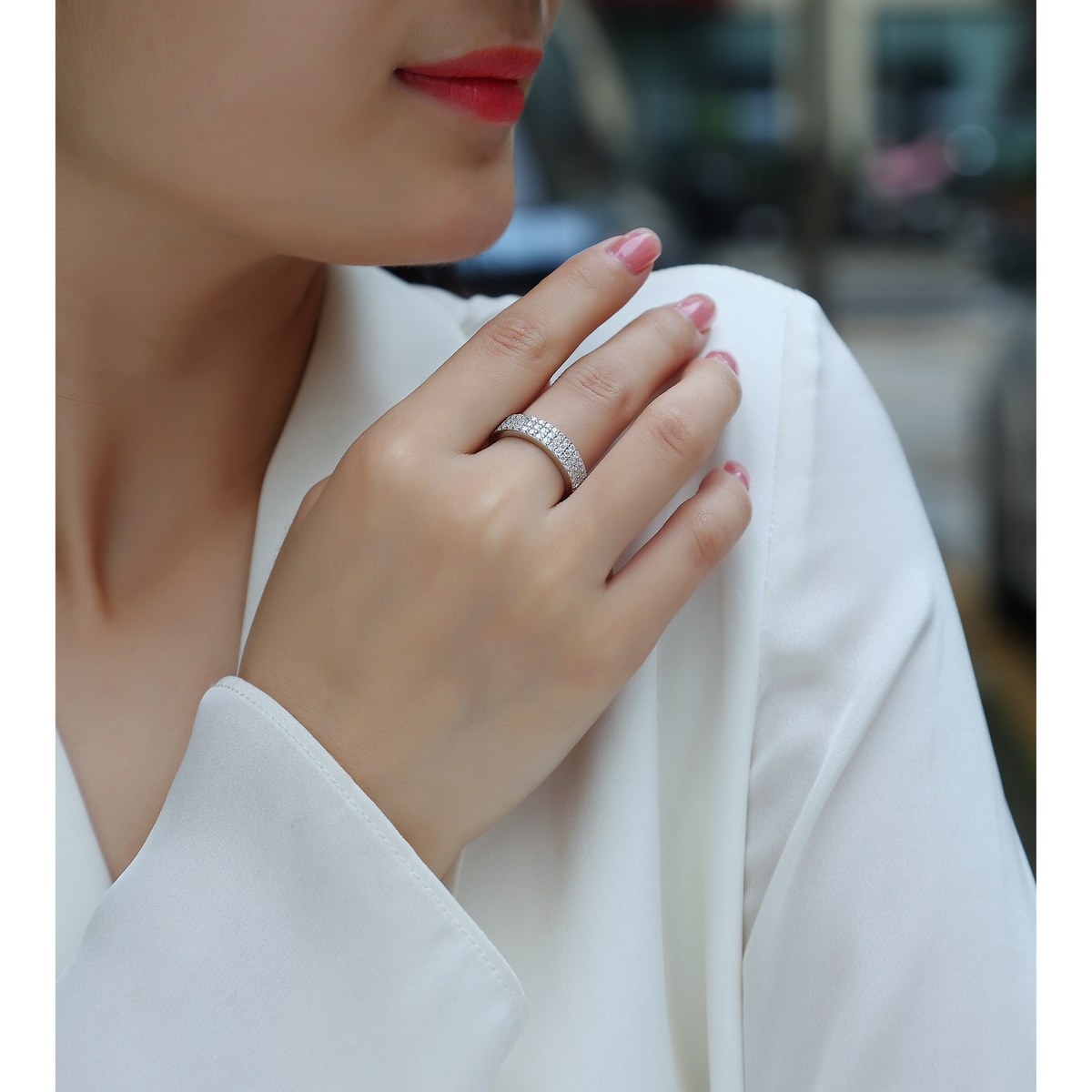
$50 to $100. This is the sweet spot, and where moissanite plus solid silver finally fits. A small moissanite pendant, a pair of moissanite studs, or a pavé ring — pieces with a real, hard stone in a solid setting, for less than the cost of a nice dinner out. This is the range where "it looks expensive" stops being a compliment and becomes the truth.
One framing tip that matters more than the list: buy the default, not the centerpiece. The pieces that get worn every day — the stud she sleeps in, the pendant she never takes off — are the ones that feel like good gifts for years. A bold statement piece under $100 almost always gives itself away as budget; a simple, well-made piece does the opposite.
The short version
- It was never the price. Affordable jewelry looks cheap because of plated metal and soft stones — two choices you can simply refuse to make.
- Buy solid 925 silver, not plated. It's the single biggest lever for "looks expensive."
- Choose moissanite over glass or CZ. Harder, brighter, and it never clouds.
- Under $50: one material done well — a solid silver pendant, studs, or a stacking ring.
- Under $100: moissanite set in solid silver — the range where "looks expensive" becomes literal.
- Buy the default, not the centerpiece. The gift that gets worn daily beats the one that impresses for an afternoon.
Keep reading
More from the Journal