How to Match Jewelry to Your Neckline (The Neckline Decides, Not the Necklace)
October 7, 2026 · 6 min read
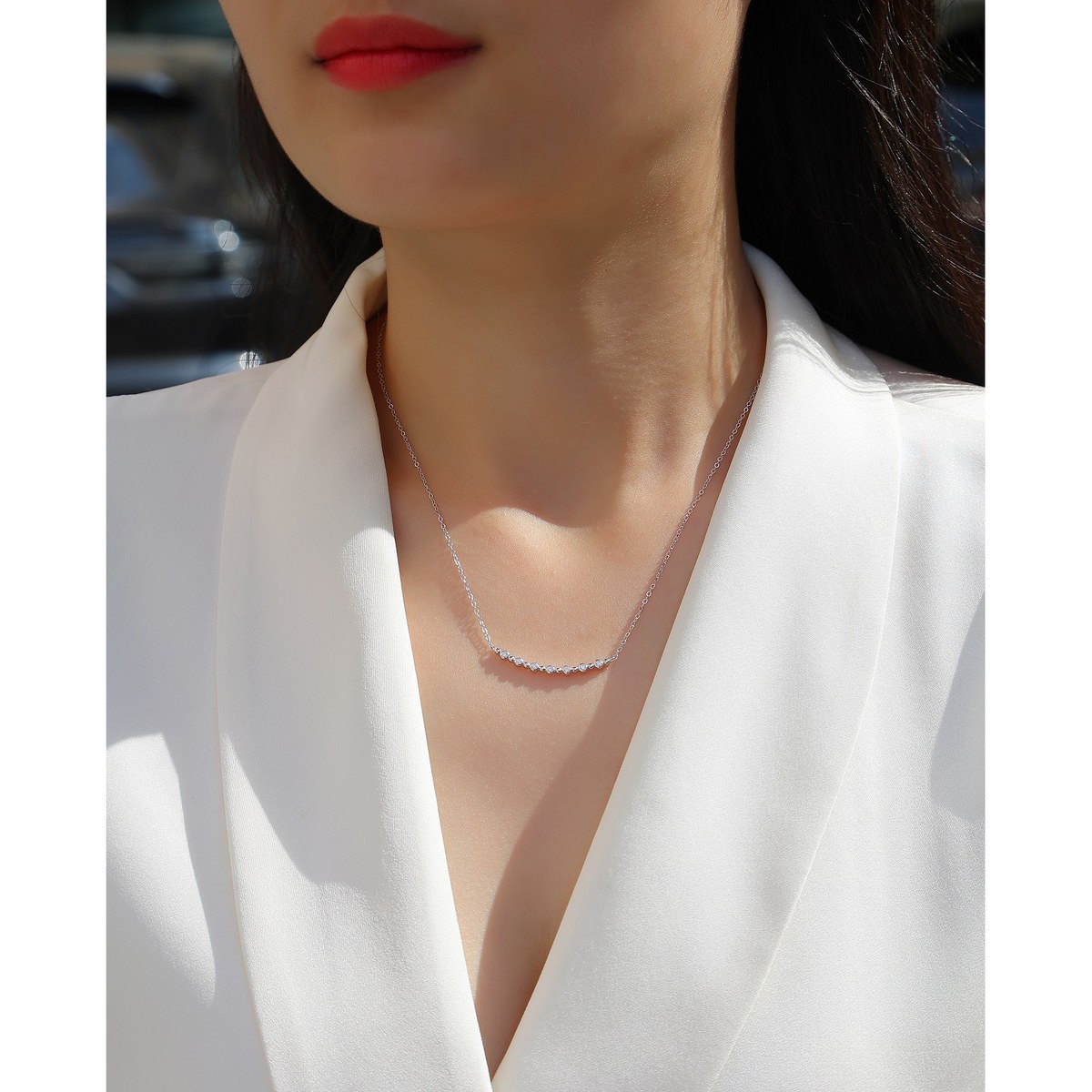
Most people buy a necklace and then wonder what to wear it with. That instinct is exactly backwards, and it's the reason so many jewelry boxes hold a dozen pieces that never quite look right. The truth is that the neckline of your top is the frame, and the jewelry is the picture inside it. You can own the most beautiful pendant in the world, and against the wrong neckline it will still look like an afterthought — while a plain chain against the right one can look deliberate and expensive. So before you buy another piece, flip the question: don't ask "what outfit goes with this necklace?" Ask "what necklace belongs in this frame?"
The frame decides the picture
Here's the honest core of it, and it's almost too simple: a neckline isn't a neutral background, it's a shape. A V-neck draws the eye down into a point. A crew neck holds everything up near the throat in a clean horizontal line. A boat neck spreads wide across the collarbones. An off-shoulder top leaves the whole area open and empty. Each of those shapes is doing something different with the space, and your jewelry is either cooperating with that shape or fighting it.
When it cooperates, you don't notice the jewelry first — you notice that the whole thing looks finished. When it fights, you get the opposite: a necklace that seems to float in the wrong place, or an earring that suddenly feels noisy. None of this is mysterious. It's the same principle as layering necklaces, where spacing and proportion do all the heavy lifting. Here, the "spacing" is the negative space your neckline is already drawing.
So the rule isn't "match the necklace to the outfit's color." It's "match the necklace's shape and length to the neckline's shape." That's a much smaller, more useful rule than most guides will admit, and it's the one that actually holds up in the mirror.
A short map: which necklace for which neckline
You don't need to memorize a chart. You need to notice what each neckline is doing, then answer it.
V-neck. A V-neck already creates a point at your chest. The necklace should echo it, not fight it — a pendant that falls just above or just inside the V, on a chain long enough to mirror the angle. A short choker against a deep V can look oddly severed from the line; a long chain that drops below the V gets lost in the fabric. Match the angle and stop.
Crew or round neck. This neckline sits high and tight, so it gives you almost no open skin to work with. That's fine — you just shorten the necklace. A short chain that sits right at the base of the throat, or a small pendant that rides just on the collar, works beautifully. The mistake is a long necklace that hangs down onto the shirt itself, where it competes with the fabric instead of framing it.
Boat neck. The line goes wide, not deep, so you want the eye to travel across the collarbones. A chain that lands right along that horizontal line — collarbone length — mirrors it perfectly. Longer chains undercut the effect by pulling the eye downward.
Off-shoulder or strapless. This is the most open neckline, and it reads as a stage. It's the one place a true statement piece earns its keep, because there's nothing else competing for the space. A single necklace with presence, worn close, anchors the whole look. But remember the layering rule: one hero, and let it breathe.
Turtleneck. A turtleneck is the necklace in a way — it already fills the neck. So the answer is usually to skip the necklace and let the earrings do the work, or wear one longer pendant that breaks the block of fabric. Trying to layer a chain over a thick turtleneck is the fastest way to look over-accessorized.
Square or sweetheart neckline. These create a defined shape at the chest, and a pendant that lands just inside that shape — echoing its line — reads as intentional. Again: echo the geometry, don't fight it.
Collared shirt. Button a shirt and you have a V-shaped opening to work with, so treat it like a shallow V-neck — a short pendant or a thin chain that sits in the gap. Leave the top buttons open and the same chain drops naturally into a deeper point. Collars are forgiving precisely because the shirt gives you the frame; you're just filling it.
Earrings do the quiet half
People forget that the neckline is also deciding your earrings, not just your necklace. The two are in conversation, and getting that conversation right is where the whole look gets its polish.
The simple version: the busier the neckline, the quieter the earring; the more open the neckline, the more room the earring has. A high, detailed collar or a statement necklace wants a small stud — anything bigger and the two start shouting over each other. A bare shoulder or an open V, by contrast, gives an earring room to be a little bolder, because there's nothing else on that side of your face competing for attention.
That's the same restraint principle from matching jewelry to your skin tone, just applied to shape instead of color: most of the time you want one element doing the leading, and everything else holding it up. A pair of bright studs — the kind that catch the light without needing to be the biggest thing in the room — is the safest default in a jewelry box precisely because it cooperates with almost every neckline. If you're unsure, that's the piece to reach for, the same way a cool, bright stone like moissanite reads well against almost anything: it supports without demanding.
And when in doubt, you can always skip the necklace entirely. A bare neck with a deliberate earring is a complete look — it isn't a missing piece, it's a choice. Some of the most elegant outfits have exactly one piece of jewelry on, and the restraint is what makes it land.
The rules worth keeping (and the ones to throw out)
Strip away the noise and you're left with a small, honest list.
Keep: match shape to shape. A necklace that echoes the neckline's angle — its point, its horizontal line, its openness — will almost always work. This is the one rule that survives contact with a mirror.
Keep: one hero per look. Necklace or earrings, not both at full volume. Everything else supports.
Throw out: "match your jewelry to your outfit's color." It's a soft suggestion dressed up as a law. Silver, especially, is neutral enough to go with nearly everything, which is why it earns its place as the most forgiving metal you can own. If a piece feels like you, the color wheel doesn't get a veto.
Throw out: "never mix lengths or finishes." The layered look is built on deliberate contrast, not uniformity. A little friction is what makes jewelry look like your life instead of a store display.
The deeper point is the same one that runs through every honest jewelry guide: these aren't rules you follow to be correct. They're shortcuts to help you when you're unsure, and the moment a piece makes you feel like yourself, the shortcut has done its job and you can put it down.
The short version
- The neckline is the frame, the jewelry is the picture — choose the necklace for the neckline, not the other way around.
- Match shape to shape: V-neck wants an echoing pendant, crew wants a short chain, boat wants collarbone length, off-shoulder wants one statement piece.
- Turtlenecks and busy collars usually call for earrings only, or one long pendant that breaks the block of fabric.
- Earrings do the quiet half — busier neckline, quieter earring; more open neckline, more room to be bold.
- One hero per look. Necklace or earrings, not both at full volume.
- Skip the necklace when it's right. A bare neck with a deliberate earring is a complete look, not a missing piece.
Keep reading
More from the Journal