How to Layer Necklaces and Stack Rings (Without Looking Like You Tried)
September 29, 2026 · 6 min read
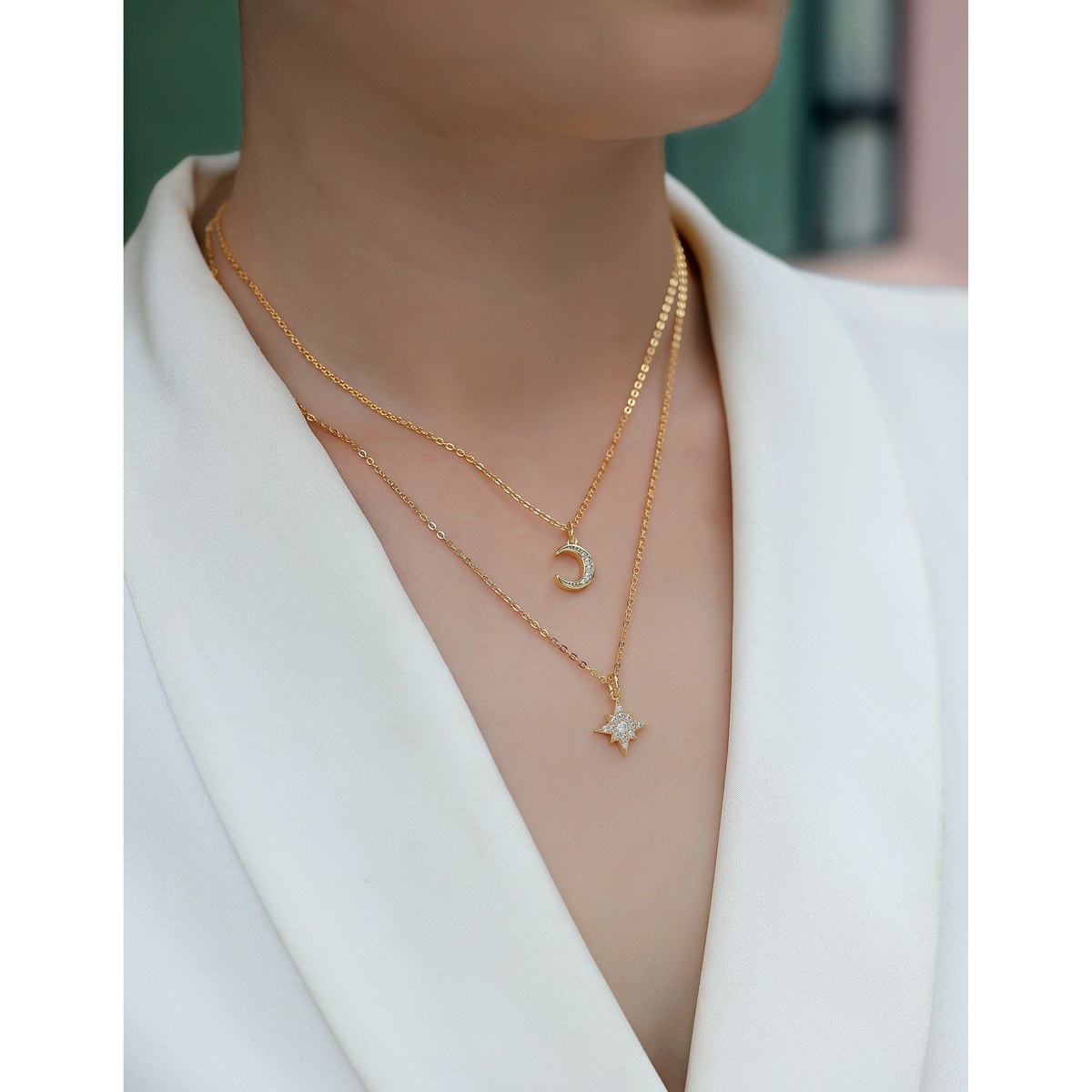
Here's the paradox hiding inside every "layered jewelry" photo you've ever saved: the look that appears to have been thrown on in thirty seconds is the most carefully arranged thing in the frame. The necklaces that read as effortless were spaced to the half-inch. The ring stack that looks like "whatever I happened to be wearing" was edited and re-edited before anyone saw it. So the first honest thing to know about layering is that it's a styling skill, not a shopping trip — and that's genuinely good news, because it means you can do it with pieces you already own, and it means the "buy a matched set" instinct you're probably about to follow is exactly backwards.
Buy fewer, not more
When someone wants a layered look, the first instinct is to buy a "layered necklace set" — three chains sold together, pre-arranged, ready to go. Resist it. That pre-matched set is the single fastest way to kill the very thing you're chasing.
Here's why. A set is three pieces that were designed together: same finish, same spacing, same temperament. Worn together they read as one piece in triplicate — uniform, polite, and a little bit sad, like a store display that followed you home. The layered looks that actually work are built from pieces that were never meant to meet: a short chain you've owned for years, a pendant someone gave you once, a longer plain chain bought for no reason at all. The friction between them — the slight difference in length, the one that catches the light while the others don't — is what makes the whole thing look like your life instead of a mannequin.
The rule is almost embarrassingly simple: contrast reads as intention, and matching reads as trying. You want the first one.
Three lengths do all the work
Necklace layering collapses down to one variable, and it isn't the pendant or the metal. It's length.
The classic look is three chains at three depths: a short one that sits near the collarbone (14 to 16 inches), a middle one around 18 inches, and a longer one that drops to 20 to 24 inches. That spacing is what creates the cascade — each chain sits in its own zone instead of tangling with its neighbor. Skip a zone and two chains will fight each other; land all three and they'll fall into place almost on their own.
For rings, the equivalent variable is number, and the number is odd. Stacks look best in threes and fives, never twos and fours. A two-ring stack reads as "I stopped halfway," while a three-ring stack reads as a decision. And don't stack identical widths — put a thin band next to a slightly wider one, maybe a small stone next to two plain bands. The same rule from necklaces applies: contrast, not matching.
Mixing metals and stones (yes, on purpose)
Somewhere along the way a rule got made that you must never mix silver and gold, and people still follow it as if it were law. It isn't. It was a rule for a different era, and the layered look is precisely where it should be broken.
A silver chain next to a warm-toned one signals that you're not precious about the whole thing — that the jewelry is yours and not borrowed from a display. That casualness is the entire point. The same goes for stones. You don't need every piece to carry a gem. In fact, a stack of nothing but sparkle looks cluttered; one stone doing the work while plain metal supports it is what gives the eye somewhere to rest.
This is where the stone itself starts to matter, and it's the honest reason moissanite pairs so well here: it's bright enough to anchor a stack without needing to be the biggest thing you own, and it costs little enough that you can wear it the way layering demands — without anxiety. If you're weighing which stone to build a stack around, our moissanite vs diamond comparison lays out the honest trade-offs without trying to sell you either one.
One statement piece. Not two.
Every layered look has a job for each piece, and most of those jobs are "support." The mistake people make is giving every piece the lead role.
The rule of restraint: one piece gets to be the main character, and everything else gets to be the cast. On a neckline, that means one pendant or one chunkier chain that draws the eye, flanked by two quieter chains. On a hand, one ring with presence — a stone, a wider band, a shape that stands out — surrounded by plain bands that hold it up. When two pieces both try to be the hero, they cancel each other out, and the whole thing reads as noise.
Think of it like a sentence. If every word is emphasized, nothing is. The power of the quiet pieces is that they make the loud one mean something. That's also why a deliberately simple piece — a plain silver band, a thin unadorned chain — is never wasted in a stack. It's doing the most important job there is.
What kills a layered look
A short list, earned the hard way:
- Over-matching. Same metal, same width, same everything. It's the pre-matched set problem, and it's why a "coordinated" stack so often looks flat.
- Too many heroes. More than one statement piece and the eye has nowhere to land.
- Ignoring proportions. A delicate stack on a heavy hand gets lost; chunky pieces on a slight frame overwhelm. Scale to the body wearing it, not the photo.
- Neglect. Layered pieces sit close together, which means they need a little more care — and care for silver is simpler than people think. Our guide to cleaning silver covers it without the folklore.
The short version
- Layering is a skill, not a shopping spree — you can do it with what you already own.
- Skip the matched set. Contrast reads as intention; matching reads as trying.
- Three lengths for necklaces (short, mid, long) so each chain sits in its own zone.
- Odd numbers for ring stacks (three, five) with mixed widths, never identical.
- One statement piece per look. Everything else supports.
- Mix metals and stones on purpose — the casualness is the whole point.
Keep reading
More from the Journal