Why Moissanite Sparkles More Than Diamond — It's Physics, Not Marketing
October 26, 2026 · 6 min read
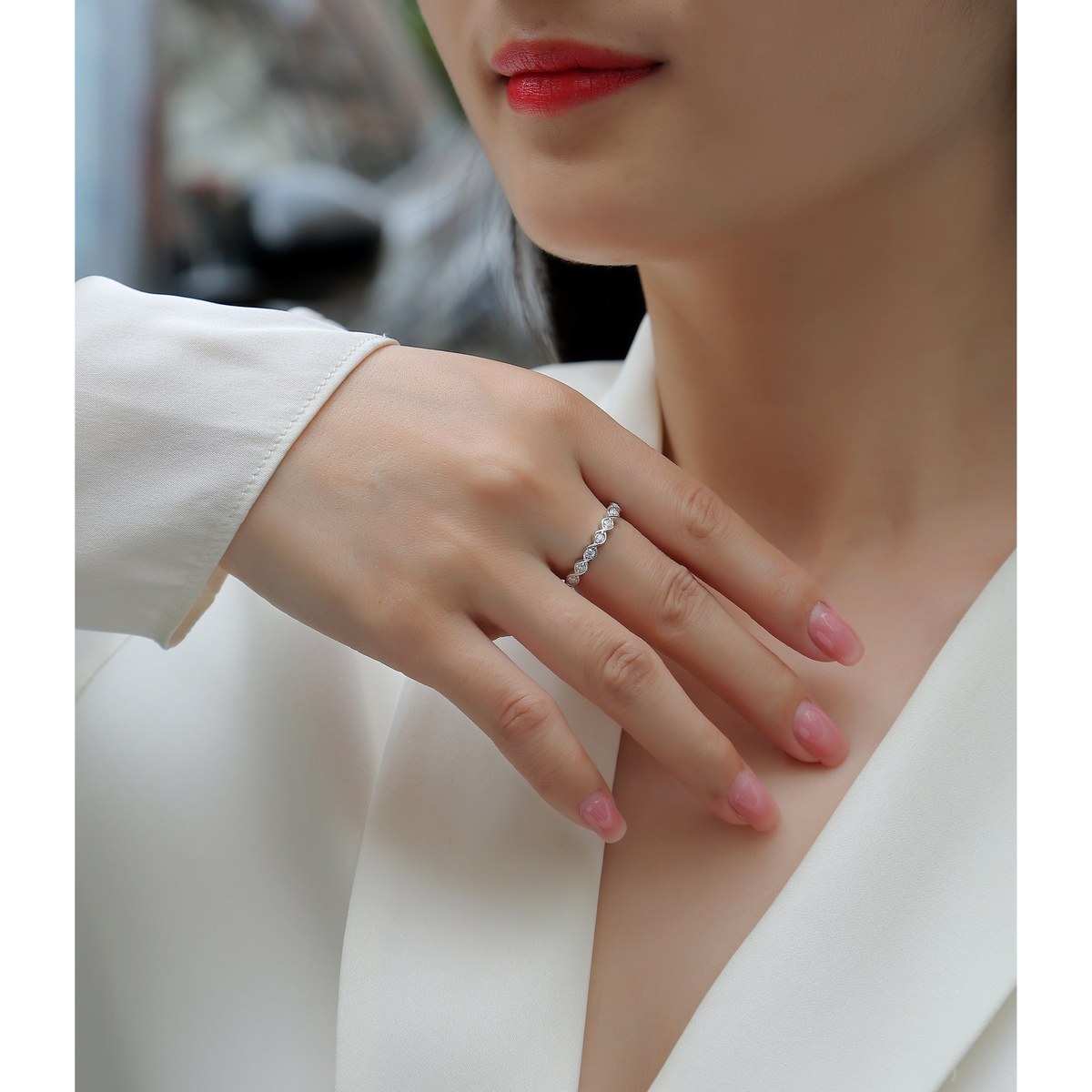
There's a claim so old and so well-advertised that almost everyone accepts it without question: diamond is the most brilliant, most sparkly gemstone on earth. It's in the ads, the movies, the proposals. And it isn't true — not as a matter of opinion, but as a matter of physics. Moissanite out-sparkles diamond. It throws more light back, and it splits that light into more color. You can measure both, with two specific numbers, the same way you'd measure temperature or weight.
So the interesting question isn't really "which one sparkles more." That part is settled. The interesting questions are why you've never heard it, and whether more sparkle is actually what you want sitting on your hand.
The two numbers that decide how a stone sparkles
Before the comparison, the two terms, because they're the whole game — and they're simpler than the jewelry counter makes them sound.
Brilliance is the white light a stone bounces back to your eye. The more light a stone catches and returns rather than letting it leak out the bottom, the brighter and more alive it looks. The number that controls brilliance is called the refractive index: how sharply a material bends light as it enters. Bend light sharply enough, and it gets trapped inside, bouncing around and coming back up instead of passing through. A higher refractive index means more light returned, which means more brilliance.
Fire is the rainbow — the flashes of color a stone throws when white light gets split into its spectrum, the way a prism does. The number that controls fire is called dispersion: how strongly a material separates white light into its component colors. Higher dispersion means more, and more vivid, rainbow flashes.
That's it. Brilliance is white light; fire is color. Every sparkle you've ever admired in a gemstone is some mix of those two, and both are governed by numbers that don't care about branding.
Why moissanite wins on paper
Here are the numbers, side by side, because they tell the story faster than any paragraph.
Diamond has a refractive index of about 2.42. Moissanite sits between 2.65 and 2.69. That's a genuinely meaningful gap — moissanite bends light more sharply, traps more of it, and returns more of it to your eye. On brilliance, the raw measure of brightness, moissanite simply has the higher number.
The gap on fire is even bigger. Diamond's dispersion is 0.044. Moissanite's is 0.104 — more than double. That's why a moissanite stone under the same light throws rainbow flashes that a diamond of the same size simply doesn't. It isn't that the moissanite is "trying to look like" a diamond and overshooting; it's that the material's optics are built to split light more aggressively.
There's one more property worth naming, because it's unique to moissanite: double refraction. Most gemstones bend light in a single clean direction. Moissanite splits every ray of light in two as it passes through — a property called birefringence. That splitting is part of what gives moissanite its extra intensity, but it also has a side effect, and the honest version of this guide is coming next.
What that actually looks like (the honest part)
So on the two numbers that define sparkle, moissanite wins. Full stop. But "sparkles more" and "sparkles better" are not the same sentence, and the second one is a matter of taste, not measurement.
Here's what the extra fire actually looks like in person. A moissanite stone tends to throw a more rainbow sparkle — lots of colored flashes, especially in direct light. Some people adore that; it's lively and catches the eye across a room. Others find it slightly busy, even a touch "disco ball," and prefer the whiter, more restrained sparkle that diamond is famous for. Neither reaction is wrong. They're describing the same physics from different preferences.
That double refraction has a real-world effect too. In larger stones, the split light can make moissanite look ever so slightly soft or less crisp at the edges compared to diamond — a faint haze that a trained eye can pick up at close range. It's not a flaw and it's not visible to most people in most settings, but it's honest to mention, because the exact same property that adds fire also softens the crispness. You don't get one without the other.
And the larger honest point: none of this makes moissanite a "fake diamond." That framing does everyone a disservice. Moissanite is a different gemstone — silicon carbide, with its own optical signature — and it happens to be measurably more sparkly in the bargain. The reason people love it as an alternative isn't that it's an imitation. It's that it's a real stone with a real, and unusually vivid, sparkle of its own. If you want the fuller story on what the stone actually is, start with what is moissanite.
The bottom line
Sparkle is physics, not value. A higher refractive index and higher dispersion don't make a stone "better" — they make it a specific kind of sparkle, and whether you love it is entirely up to you. If you want maximum fire, the vivid rainbow flashes, the brightness that draws the eye — moissanite is the objectively correct answer, and the numbers prove it. If you want the whiter, more understated brilliance that diamond is famous for, then diamond is your stone, and no amount of rainbow will substitute for that specific look.
The only real mistake is buying either one without knowing which kind of sparkle you actually love. Now you know how to tell the difference — with numbers, not vibes.
Keep reading
More from the Journal